Imagine packing your whole life onto a wagon. Your two little boys sit beside you. Behind you is a government that hurt your family. Ahead of you is a war zone. You do not know where you will sleep tonight. This is how The Last Green Valley begins.
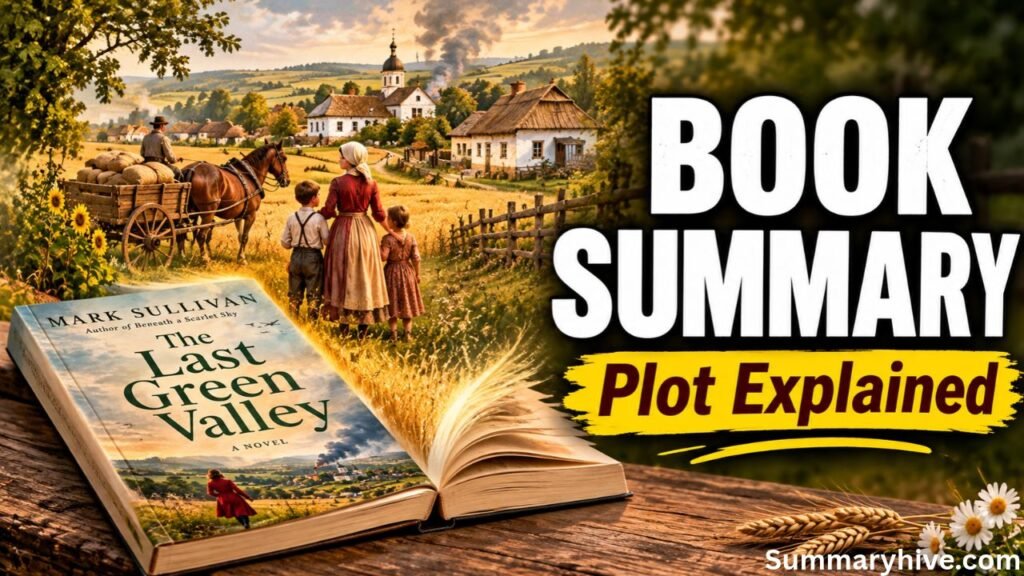
Written by Mark Sullivan, the author of Beneath a Scarlet Sky, this historical fiction novel came out in 2021. It follows a real family, the Martels, as they try to escape the Soviet Union during World War II. You may be here because you are deciding whether to read it, because your book club picked it, or because you need a quick refresher. You are in the right place.
The book The Last Green Valley is big and emotional. It covers seven years, from 1944 to 1951, and it includes flashbacks to earlier times. It has a lot of characters and a lot of history. That can feel like too much to hold in your head.
This guide makes it simple. You will find a spoiler-free summary first, then a full summary with spoilers. After that come the characters, the ending explained, the themes, the true story, and the real history behind it. You will also get book club questions and similar books to try next.
Everything here is written in plain, simple words. You do not need to know anything about Eastern Europe or World War II to follow along.
Quick Answer: What Is The Last Green Valley About?
The Last Green Valley is a 2021 historical novel by Mark Sullivan. The Last Green Valley it tells the story of Emil and Adeline Martel, an ethnic German family from Ukraine. In 1944 they flee the advancing Soviet forces with their two young sons and many relatives. The family crosses Eastern Europe during World War II, and Adeline holds on to a dream of finding a peaceful green valley where they can finally live in freedom. The story is based on the real Martel family’s journey.
What Is The Last Green Valley About? (Book Overview)
At its heart, this is a survival story about a family trying to stay together. It is also a love story. Emil and Adeline lean on each other through hunger, fear, and long separations.
Also Read:/the-lion-women-of-tehran/
Quick book facts:
- Title: The Last Green Valley
- Author: Mark Sullivan
- Publisher: Lake Union Publishing
- Published: May 4, 2021
- Length: About 458 pages (hardcover)
- Genre: Historical fiction, survival fiction, literary fiction
- Main time span: 1944 to 1951, with flashbacks from about 1929 to 1941
- Main setting: Ukraine, Romania, Poland, and Germany, moving west
The book The Last Green Valley is told in a close, personal way. You feel what the family feels. When they are cold, you feel cold. When they are afraid at a checkpoint, your heart beats faster too.
Good to know before you start: This is not a light read. It includes violence, hunger, and war cruelty, and parts are hard to read. It also has real hope in it, and many readers say it leaves them feeling uplifted.
Who Is Mark Sullivan, and Is The Last Green Valley a True Story?
Mark Sullivan is an American author of historical fiction and thrillers. His book Beneath a Scarlet Sky (2017) became a New York Times bestseller. It was also picked up for a movie. Fans of that book often look for his next one, which is how many people find The Last Green Valley.
Is it a true story? Yes, it is based on one. The novel The Last Green Valley is a novelization of the real Martel family’s escape. Sullivan built it from interviews and research. That is why it is called historical fiction based on true events, not a plain history book.
Here is what that means:
- The big journey is real. A real family fled Ukraine and made their way west.
- Some scenes, talk, and small details are imagined. No author can know every word spoken eighty years ago.
- The history around the family is real. This includes Stalin’s rule and the war.
So you can trust the overall shape of the story. Treat individual conversations as the author’s careful guess at what happened.
The History Behind the Book: Stalin, Hitler, and Ukraine
You do not need to be a history expert. A few simple facts make the book much easier to follow.
1. Stalin’s Ukraine. In the early 1930s, the Soviet government under Stalin took farmland and grain from farmers in Ukraine. This led to the terrible Ukrainian famine of 1932–1933, known as the Holodomor. Millions of people died. Families like Adeline’s grew up in the shadow of this hunger and fear. The Soviet secret police also arrested many people. In the book The Last Green Valley, this includes Adeline’s father.
2. Nazi occupation. In 1941, Nazi soldiers invaded the Soviet Union and took over much of Ukraine. This brought a different kind of danger, with its own cruelty.
3. Retreat and escape. By 1944, the Soviet forces were pushing back. Many ethnic Germans in Ukraine feared what the Soviets would do to them. Some chose to flee west with the retreating German army.
That last point is the heart of the book’s The Last Green Valley moral problem. The Martels hate what the Nazis stand for. But they fear Stalin’s regime, including forced deportation and Siberian labor camps. They feel trapped between two evils. The Historical Novel Society review also notes that the author is careful to show how much the Martels dislike this situation.
Meet the Martels: A German Family in Ukraine, The Last Green Valley
Why was a German family living in Ukraine? It is a fair question, and the book The Last Green Valley answers it.
Hundreds of years ago, German farmers moved to the lands that are now Ukraine. They kept their language and traditions, and families like the Martels lived there for generations. They are called ethnic Germans, or people of German heritage, but they were not from Germany itself.
This made life hard in the 1900s. In the Soviet Union, they were treated with suspicion because they were German. When the war came, they were caught in the middle. They were Ukrainian neighbors to some and “Germans” to others, and they had little choice about what happened next.
The main Martel family group:
- Emil Martel: The husband and father, a strong farmer.
- Adeline Martel: His wife, a woman of deep faith who dreams of a green valley.
- Waldemar (Walt) and Wilhelm (Will): Their two young sons.
- Johann and Karoline Martel: Emil’s parents.
- Rese Martel: Emil’s sister.
- Lydia and Malia Losing: Adeline’s mother and sister.
The Last Green Valley Summary (Spoiler-Free)
In 1944, World War II is turning against Germany. The Soviet forces are moving closer to the Martels’ farm in Ukraine. Emil and Adeline Martel know what the Soviets did to families like theirs in the past. They decide they cannot stay.
So they pack up and join a long line of refugees heading west. They bring their two small boys, Walt and Will, along with grandparents, in-laws, and other relatives. When Will asks where they are going, Adeline gives him a simple, hopeful answer: a beautiful green valley with mountains and forests.
The trip is not easy. The family faces hunger, sickness, cold weather, and danger at every border. Emil is pulled into a war he never wanted. Adeline must protect the children and the older relatives mostly on her own. The family is tested again and again, and being together matters more than anything.
The big question that drives the book is simple: will the Martels stay alive, stay together, and find their green valley?
The Last Green Valley Full Summary (With Spoilers)
The flight begins (1944). The Martels leave Ukraine with a refugee caravan under the protection of the German army. They do not like this choice at all. They dislike the Nazis, but they fear Stalin’s regime even more. Along the way, they cross parts of Eastern Europe, including Romania. Adeline keeps telling the boys that each stop is just a step toward the green valley.
The refugee camp. By June 1944, the Martel and Losing families are staying in a refugee camp. Emil is forced to serve under a harsh officer, Major Haussmann. When Emil refuses to follow cruel orders, the Major punishes him in a very scary way. He fires a gun at Emil but deliberately misses. Then he warns that Emil’s family will pay for Emil’s “cowardice.” From then on, the family is under constant threat.
Sickness and loss of hope. The war drags on and food runs low. Emil’s sister Rese becomes addicted to painkillers. Later, Emil himself gets very sick. Adeline hides how bad the food situation is so that he can focus on getting better. Another terrible moment comes when Emil is ordered to hurt innocent people, including two little girls, and he cannot do it.

Separation. As the war ends, the family is split apart. In the postwar chaos, Adeline has to take care of the boys without Emil. Lieutenant Gerhardt, an official in Soviet-controlled Germany, warns her that Emil is an enemy of the state. He says she could be arrested or even killed if she tries to join him.
The border. Emil sends word that Adeline and the boys must sneak across the border before it closes for good. This is one of the tensest parts of the story. She has to decide whether to take the risk.
The final stretch. The family’s years in postwar Europe lead them toward a new life across the ocean. The book ends in 1951.
Timeline of Key Events in The Last Green Valley
This simple timeline helps you keep the years straight, since the book jumps back in time.
| Year | What Happens |
|---|---|
| 1929–1941 | Flashbacks show the families’ earlier lives under Soviet rule |
| 1932–1933 | The Ukrainian famine (Holodomor) brings terrible hunger |
| 1933 | Adeline works for Mrs. Kantor, who encourages her to marry Emil |
| 1941 | Nazi soldiers invade and occupy Ukraine |
| March 1944 | Emil and Adeline decide to flee as Soviet forces advance |
| 1944 | The caravan travels west and the family stays in a refugee camp |
| 1944–1945 | Sickness, separation, and Major Haussmann’s threats |
| After 1945 | Life in postwar Germany and the border crossing |
| 1951 | The family’s long journey reaches its end |
Reading tip: If you get lost, look at the chapter’s year first. Flashbacks always return to the 1930s, while the main story stays in the 1940s.
Main Characters in The Last Green Valley
Character: Emil Martel, The Last Green Valley
Role & Arc: Emil is a strong farmer and a loving husband and father. At the start he is practical and guarded. Under Major Haussmann he is pushed into terrible choices. He also becomes more thoughtful and, through his friendship with Corporal Gheorghe, regains his faith. His journey is about holding on to his goodness when the world is cruel.
Character: Adeline Martel, The Last Green Valley
Role & Arc: Adeline is the heart of the book. Her faith and hope keep the family going. She first learns about the “green valley” from the books of her old employer, Mrs. Kantor. When Emil is gone, Adeline becomes the family’s leader. She changes from a young wife into a brave, determined protector.
Character: Waldemar “Walt” Martel, The Last Green Valley
Role & Arc: The older boy, about four when the journey begins. He sees the world through a child’s eyes, which helps readers feel how scary and confusing the war is.
Character: Wilhelm “Will” Martel,The Last Green Valley
Role & Arc: The younger son, almost two at the start. He is cheerful and keeps asking about the green valley, which gives Adeline a reason to keep talking about hope.
Supporting Characters You Should Know in The Last Green Valley
You do not need to memorize every name. These are the ones who matter most.
- Lydia Losing: Adeline’s mother. Her husband, Karl, was arrested by the Soviet secret police when Adeline was a child. Lydia carries that sorrow with her.
- Malia Losing: Adeline’s older sister. A mule kick when she was fifteen left her with permanent brain damage. She stays free-spirited and finds small moments of joy even in hard times.
- Johann and Karoline Martel: Emil’s parents. They represent the older generation, who have lived through the worst of Stalin’s Ukraine.
- Rese Martel: Emil’s sister. Her struggle with painkillers shows how war damages people in quiet ways too.
- Mrs. Kantor: An elderly Jewish woman who hired Adeline as a cook in 1933. She is a kind mentor who encouraged Adeline to marry Emil. Her books gave Adeline the picture of the green valley.
- Esther: A friend of Adeline’s who appears along the journey.
- Major Haussmann: The main villain. A harsh German officer who punishes Emil and threatens his family.
- Corporal Gheorghe: A trusted friend to Emil. His teachings help Emil rebuild his faith.
- Peter Schmidt: A rival who harasses Emil and threatens to expose his secrets to the authorities.
- Lieutenant Gerhardt: The official who warns Adeline she could be arrested if she tries to reach Emil.
The Last Green Valley Ending Explained
Short answer: Yes, the ending is hopeful. Emil and Adeline survive the war, are reunited, move to America, and build a good life in Montana. The cost is high, though. Not every family member makes it, and the war leaves marks that never fully fade.
Here is how it unfolds, step by step:
1. Adeline’s dangerous border crossing (March 1947). For years, Adeline and the boys are stuck in Soviet-controlled Germany. Emil is already in the West, and the two write each other in a secret code because an official reads their mail. When the border is about to close for good, Adeline takes the biggest risk of her life. She travels by train to Berlin, then to the last stop before the British Zone. She bribes a train conductor, hides from Soviet soldiers, and sneaks past a guardhouse with her sons. A stranger then helps her carry the broken little wagon across the line.
2. The reunion. From a bakery phone in West Germany, Adeline calls the displaced persons camp in Alfeld, where Emil is waiting. Hours later, the family is reunited at the train station. They treat every day afterward as a gift.
3. Justice for Major Haussmann. In the hospital, Emil finally tells Adeline about his hardest memory, his encounter with Major Haussmann years earlier. Adeline agrees with Gheorghe that Emil showed real courage. Emil also learns from a newspaper that the Major was arrested after the war. He took his own life in jail before he could face trial at Nuremberg.
4. The trip to America. A long-lost uncle of Adeline’s agrees to sponsor the family if they work on his farm. In September 1951, the Martels board a ship in Bremerhaven. A week later they reach New York, then travel by train to Baker, Montana. The relatives there are not very welcoming, so the family soon leaves the farm. Emil gets a job mixing concrete and helps build the town’s first hospital.
5. The green valley at last. Years later, Adeline and Emil are driving near Bozeman when a rainstorm sends them down a gravel road. When the rain clears, they see a wide valley in “a hundred shades of green.” Adeline realizes that the Gallatin Valley is the place she has dreamed about since she was a young woman. They never live anywhere else.
6. What happens to everyone. The book ends with a look at later years:
- Emil starts a construction company that grows with his sons’ help.
- Emil’s brother, Reinhold, survives 26 years in a Siberian labor camp.
- Emil’s father, Johann, dies on the way back to Ukraine after the war.
- Rese struggles with addiction and refuses to leave Eastern Europe.
- Malia stays cheerful through a hard life.
- Emil dies of cancer in 1987. Adeline lives to age 90 and dies in 2006.
Why the ending works: It does not pretend that happiness erases pain. The sons still carry war memories into adulthood. Some relatives never get a happy ending. That balance is what makes the hope feel earned.
Key Themes Explained, The Last Green Valley
1. Faith and Hope
Faith is the strongest theme. Adeline prays, even when she fears nobody is listening. Emil loses his faith during the war and then rebuilds it through his friendship with Corporal Gheorghe. By the end, the family sees ordinary days as small miracles.
Why it matters: The book suggests that hope is not just a feeling. It is something people choose to practice, especially when things are bad.
2. The Cruelty of War, The Last Green Valley
War does not end when the fighting stops. In this book, hunger, sickness, family separation, and forced deportation continue for years. Even in safe Montana, the sons are shaken by loud noises and conflict, which echo their childhood fears.
3. Family Love and Sacrifice, The Last Green Valley
Nearly every big decision is made to protect someone else. Adeline risks arrest to cross a border. Emil refuses a terrible order even though it puts his family in danger. The book shows that love often means giving something up.
4. Moral Choices Under Pressure
Emil faces a hard question: how do you stay a good person when someone forces you to do wrong? The book does not give an easy answer. It shows that choosing conscience can be very costly, yet it is worth it.
5. Gratitude After Suffering
Adeline’s advice near the end is to find something good, even in hard times. Not everyone agrees with this outlook, and the book shows that some, like Rese, grow bitter instead. Still, the Martels’ gratitude is a big part of why they survive.
6. Freedom and Home
The characters wonder why some people run toward freedom while others stay in misery. The story suggests that home is more than a place. It is also a feeling of peace.
Symbolism in The Last Green Valley
The Green Valley. This is the biggest symbol. Adeline first saw a picture of a green valley in a book belonging to Mrs. Kantor. Ukraine is mostly flat farmland, so the image stuck with her as a symbol of peace and freedom. When Will keeps asking, “Are we there yet?”, Adeline tells him each stop is only a step on the way. The idea grows from a real place into an attitude. The family finds the actual valley in Montana, but the book The Last Green Valley also says peace can be found along the way.
Wagons and Trains. Moving vehicles show a life without a home. The broken wagon in the last border crossing is a small but strong image. It is damaged and still keeps moving, just like the family.
Letters and Codes. The secret letters between Emil and Adeline stand for love that survives under watchful eyes.
Books. Mrs. Kantor’s books The Last Green Valley gave Adeline a dream. This shows how stories can plant hope in a person.
Weather and Color. The book moves from mud, snow, and grey misery to bright color at the end. The change in scenery matches the change in the family’s lives.
Writing Style, Pacing, and Honest Review
Is The Last Green Valley good? Most readers say yes, especially those who enjoy emotional historical fiction. It is a strong pick for fans of The Nightingale and Beneath a Scarlet Sky.
What works well:
- Strong, caring characters. You will root for Adeline and Emil.
- A real history lesson. Many readers did not know about the ethnic German experience in Ukraine.
- A hopeful center. Even the darkest chapters lead somewhere.
- A clear style. The writing is plain and easy to follow.
What some readers find harder:
- Uneven pacing. Some parts move fast, while others feel slow.
- Predictable moments. If you read a lot of war fiction, some turns may feel familiar.
- Heavy content. There are scenes of violence and cruelty.
- Moral complexity. The Martels travel under German protection, which some readers find uncomfortable. The book tries to be honest about how little choice they have.
Our take: If you want a moving, inspired-by-true-events story about survival and hope, this one delivers. If you prefer fast thrillers, you may find it slower than expected.
Common Misconceptions About The Book, The Last Green Valley
Misconception 1: “The Martels support the Nazis.”
Reality: They don’t. They flee Stalin’s regime and reluctantly travel under German army protection because they have few other options. The book The Last Green Valley makes clear how much they dislike the Nazi cause.
Misconception 2: “It’s a pure history book.”
Reality: It’s historical fiction. The journey is based on a real family, but some conversations and details are imagined.
Misconception 3: “The green valley is in Ukraine.”
Reality: The dream is of a place with mountains and forests, unlike the flat farmland of Ukraine. The family finds it in Montana’s Gallatin Valley.
Misconception 4: “It’s only a war story.”
Reality: It’s just as much about faith, marriage, and family. The war is the setting, not the whole point.
Misconception 5: “Everyone gets a happy ending.”
Reality: The Martels do well, but others in the family suffer or die. The book is honest about loss.
Misconception 6: “The Holodomor is the main story.”
Reality: The 1932–1933 famine and Soviet persecution are part of the background, but the main events are the 1940s escape and its aftermath.
Who Should Read The Last Green Valley?
Short answer: Read it if you like emotional historical fiction about family survival and want to learn something new about World War II.
You will probably enjoy it if you:
- Loved The Nightingale or Beneath a Scarlet Sky
- Like true-story-inspired novels about courage and resilience
- Are curious about Ukrainian refugees, ethnic Germans, or postwar Europe
- Want a story with faith, hope, and a real ending
- Need a strong pick for a book club

You might want to skip it if you:
- Want a fast, action-packed thriller
- Prefer light reading (the book has violence and war cruelty)
- Dislike slow stretches in the middle
Book Club Discussion Questions
These questions work well for groups. Pick the ones that fit your time.
- Why do you think Adeline’s green valley dream stays so strong, even when things go wrong?
- The Martels travel under German army protection even though they dislike the Nazis. How did you feel about that choice?
- Emil refuses a terrible order from Major Haussmann. Was his choice brave, risky, or both?
- How does faith change for Emil and Adeline over the years?
- Which character did you admire most? Why?
- What did Mrs. Kantor give Adeline, besides a job?
- Adeline says to find something good in every hardship. Do you agree? Why did Rese react differently?
- How does the story show that war damages families even after it ends?
- Did the ending feel earned? What would you have changed?
- What did you learn about Ukraine, Stalin’s regime, or postwar Germany that surprised you?
- How does the book balance hope and heartbreak?
- Is the true-story angle important to you when reading historical fiction?
Frequently Asked Questions About The Last Green Valley
What is The Last Green Valley about?
It is a 2021 historical novel about Emil and Adeline Martel, an ethnic German family who flee Ukraine in 1944 to escape the Soviet forces. They travel west through war-torn Europe, hoping to find a peaceful green valley.
Is The Last Green Valley a true story?
It is based on a true story. The novel The Last Green Valley is a novelization of the real Martel family’s journey, built from interviews and research. Some scenes and dialogue are imagined.
Who wrote The Last Green Valley?
Mark Sullivan, the author of Beneath a Scarlet Sky. It was published by Lake Union Publishing on May 4, 2021.
How does The Last Green Valley end?
The Martels are reunited in West Germany after Adeline’s dangerous border crossing. In 1951 they sail to America and settle in Montana. Adeline finds her green valley in the Gallatin Valley near Bozeman.
What is the main theme?
Faith and hope are the main themes. Other big ideas are family love, sacrifice, the cruelty of war, and gratitude after suffering.
What does the green valley symbolize?
It stands for peace, freedom, and home. It begins as a picture from a book and becomes a real place in Montana.
Who is the villain?
Major Haussmann, a harsh German officer who punishes Emil and threatens his family. The book The Last Green Valley also shows the larger evils of Stalin’s regime and the war.
Do the Martels support the Nazis?
No. They flee Stalin’s rule and travel under German protection only because they feel they have few options.
Why were Germans living in Ukraine?
Their ancestors moved there generations ago to farm. They kept their German heritage, which later made them targets of suspicion under Soviet rule.
How long does the story take?
The main story The Last Green Valley runs from 1944 to 1951, with flashbacks to events from about 1929 to 1941.
Is it a sequel to Beneath a Scarlet Sky?
No. It is a separate story by the same author. You can read either one first.
Is The Last Green Valley worth reading?
Yes, if you enjoy emotional, hopeful historical fiction. Some readers find the pacing uneven and the content heavy, but many call it inspiring.