The Sword of Kaigen by M. L. Wang is a Japanese inspired fantasy novel about a mother and son from a legendary warrior family, both hiding truths from each other while the empire they serve hides truths from everyone. It’s part martial arts fantasy, part quiet family drama, and part sharp political story about what happens when government propaganda finally cracks.
This article gives you a complete sword of kaigen chapter summary, broken into a spoiler-free overview and a full, spoiler-heavy plot breakdown so you can choose how much you want to know. Beyond the plot, you’ll get a full rundown of the Kaigenese warrior families, an explanation of the elemental magic system and the Whispering Blade, character profiles for Misaki, Mamoru, and the rest of the cast, and a clear look at the book’s central themes — from family sacrifice to tradition versus modernity.
We cross-checked every detail here against the original novel and multiple reader sources, so nothing is guessed or invented. By the end, you’ll know exactly what happens in Takayubi, how the story ends, and whether this epic fantasy book deserves a spot on your shelf.
Maybe you just finished The Sword of Kaigen and your heart is still racing. Maybe you’re deciding if this book is worth your time. Or maybe you need a sword of kaigen chapter summary to refresh your memory before a book club chat. Whatever brought you here, you’re in the right place.
The Sword of Kaigen is a 2019 adult fantasy novel by M. L. Wang. It is set in a Japanese inspired fantasy world where families fight with elemental magic instead of guns. The story follows a mother and son who both hide big secrets from each other — and from themselves.
This guide gives you everything: a clear plot summary, a breakdown of every main character, the book’s biggest themes, and answers to the questions readers search for most. We read the book closely and checked our facts against the original text and other trusted reader guides, so you can trust what’s here.
The Sword of Kaigen Quick Answer
The Sword of Kaigen tells the story of Misaki, a former warrior turned quiet housewife, and her son Mamoru, a boy raised to fight for an empire built on lies. When a friend reveals that their government has hidden the truth about ongoing wars, Mamoru begins to question everything — right as a real enemy attack reaches their mountain village of Takayubi. The book is part war story, part family drama, and part meditation on truth versus propaganda. It works fully as a standalone fantasy book, even though it shares a universe with Wang’s other novels.
The Sword of Kaigen Book Overview and Background
At its heart, The Sword of Kaigen is a story about a family that looks strong on the outside but is quietly breaking on the inside. It blends epic fantasy scale with a very personal, intimate focus on just one household.
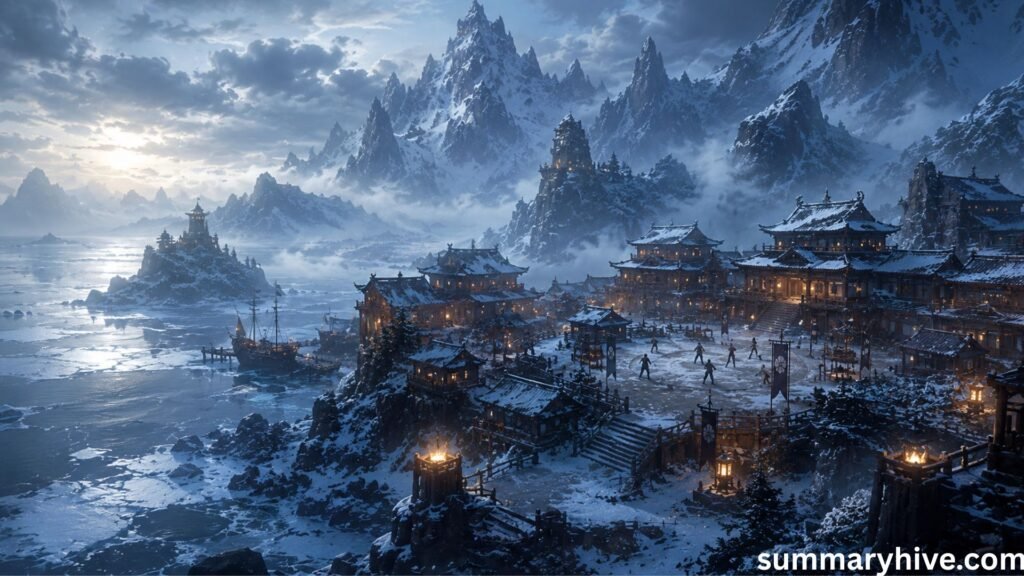
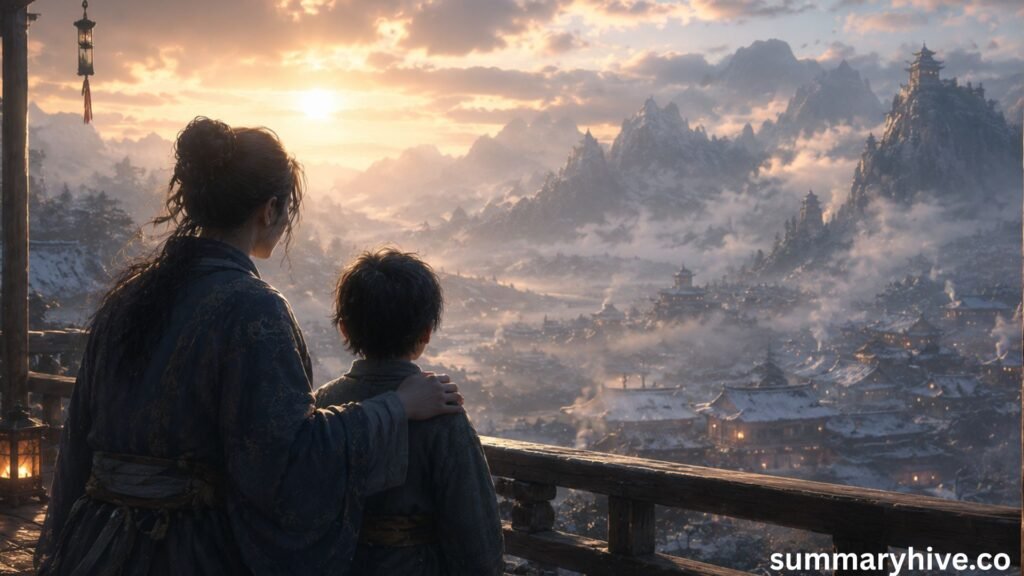
Genre and setting: The book is adult fantasy with heavy martial arts fantasy elements. It takes place in the Kaigenese Empire, a world clearly inspired by real Japanese history and culture, though it is entirely fictional. The action centers on Takayubi, a remote mountain village on the Shirojima Province‘s Kusanagi Peninsula — nicknamed “the Sword of Kaigen” because its warriors are supposed to be the empire’s first line of defense.
Publication context: M. L. Wang originally self-published the novel in 2019. It did not become an instant bestseller. Instead, it built a devoted following slowly, mostly through word of mouth and online book club communities, before a wave of new readers discovered it years later on social media. Today it holds an unusually high average rating among fantasy readers, and many long-time fantasy fans call it one of the best hidden gem novels of the last decade.
What you need to know going in: The novel belongs to Wang’s wider Theonite universe, where certain bloodlines carry magical powers. You do not need to have read anything else by Wang first — this book stands completely on its own.
The Sword of Kaigen Spoiler-Free Summary
If you have not read The Sword of Kaigen yet, this section is safe for you.
Fourteen-year-old Mamoru Matsuda has grown up believing his purpose in life is simple: master his warrior family‘s fighting techniques and defend his homeland. He belongs to the Matsuda warrior family, the most respected bloodline in Takayubi, famous for a legendary technique called the Whispering Blade.
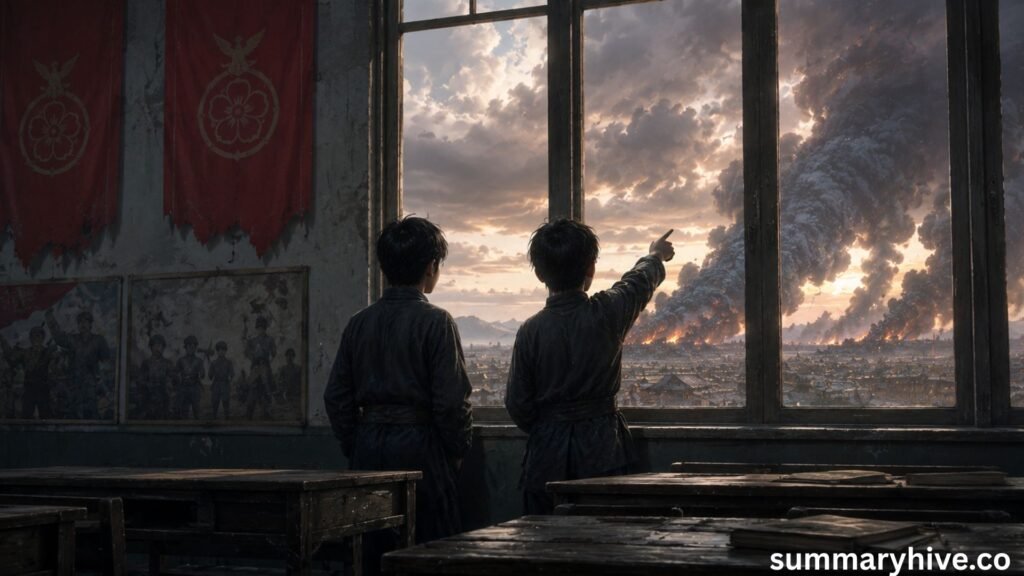
Then a new transfer student, Kwang Chul-hee, arrives at Kumono Academy and starts asking uncomfortable questions — questions about the empire’s supposed age of peace, and whether the wars Mamoru has been trained to fight are even what he’s been told they are.
Confused and searching for answers, Mamoru turns to his mother, Misaki. She seems like an ordinary, quiet housewife. But Misaki is hiding a past that not even her husband fully knows about — a past that includes real combat training, a life abroad, and a kind of power the Matsuda house does not fully understand.
When danger finally reaches Takayubi, everything the family has buried comes rushing to the surface at once.
That’s all we’ll say without spoilers. If you want the full story, keep reading below.
The Sword of Kaigen Full Plot Summary (With Spoilers)
The novel The Sword of Kaigen opens in Takayubi, a village where every child is trained from a young age to fight using water and ice magic. Mamoru trains hard, believing that if he works hard enough, he will one day achieve the Whispering Blade, the rare and revered technique passed down through his father’s line.
Mamoru’s world starts to crack when his new friend Kwang Chul-hee tells him the empire has been lying about “peacetime.” Chul-hee explains that the government uses propaganda to hide ongoing conflict and treats soldiers as cannon fodder for the ruling class’s benefit. Shaken, Mamoru brings his doubts to his mother, Misaki — but she gives him only partial answers, unwilling to reopen old wounds.
Misaki’s backstory unfolds in flashback layers throughout the book. Before marrying into the Matsuda family, she trained at a foreign theonite academy, excelled in combat, and lived a life completely different from the quiet, obedient wife role she plays now. She gave it all up for her husband, Matsuda Takeru, a cold and emotionally distant man who has no idea what his wife is truly capable of.
Strange storms begin hitting coastal towns near Shirojima. Mamoru realizes these “storms” are actually a cover story for real attacks carried out by the Ranga Union. When he confronts his father with this theory, Takeru is furious, calls him disloyal, and challenges him to a formal duel — which Mamoru loses badly. Rather than let him remain unprepared, Misaki secretly begins training her son in real combat, defying her husband’s wishes for the first time.
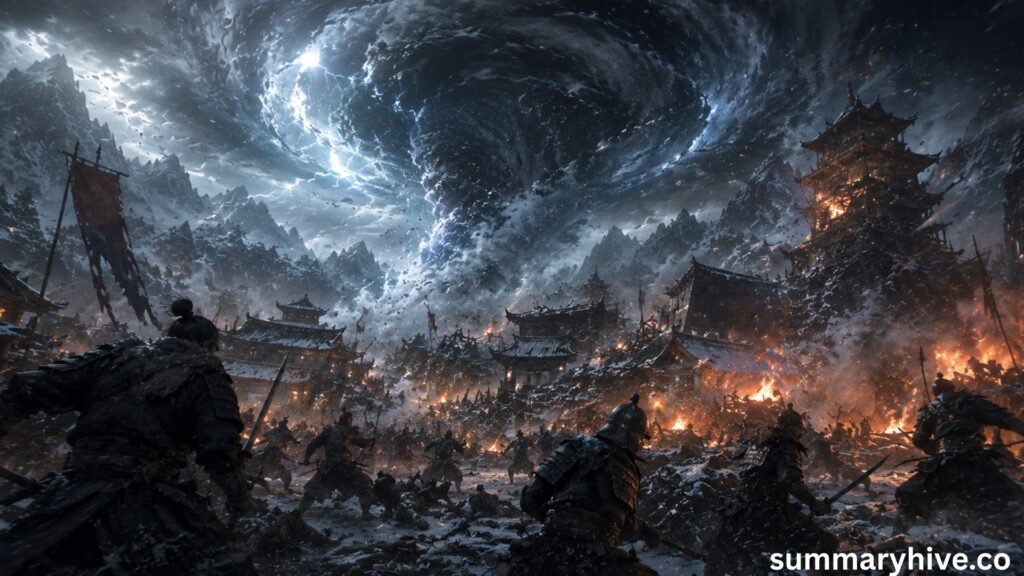
The warning comes too late. Misaki receives a letter from an old friend confirming that a Ranganese invasion of Takayubi is imminent. Before the family can flee, the attack begins — and it is far larger and more coordinated than anyone in the village imagined, using weaponized wind and storm tactics the Kaigenese military had refused to take seriously.
Mamoru fights bravely alongside the village’s men, using everything Misaki secretly taught him. In the chaos, he achieves the Whispering Blade for the first time — and dies in the same battle, killed after a brutal duel that buys crucial time for others to survive.
Misaki, upon learning of her son’s death, breaks completely. She retrieves the sword she buried years earlier and fights back with lethal, practiced skill the village never knew she had, saving lives in the process, including rescuing her sister-in-law from an attacker.
In the aftermath, the empire’s military arrives — not just to help, but to cover up what really happened, forcing the village to claim the deaths came from a natural storm and denying families the right to properly bury their dead. Grief-stricken and furious at her husband’s paralysis in the crisis, Misaki finally confronts Takeru directly. In an emotional reckoning, he admits that his coldness was never strength — it was fear. The two of them see each other honestly for the first time in their marriage, and slowly begin to rebuild what’s left of their family and their village.
The World of Kaigen: Setting and Background
The Kaigenese Empire is the beating heart of this fantasy world building, and understanding it makes every scene land harder.
Takayubi sits on the Kusanagi Peninsula, a rugged, snow-covered stretch of land in Shirojima Province. For generations, the empire has told its people that this peninsula’s warriors are the reason Kaigen has never fallen to invasion — earning the region its nickname, “the Sword of Kaigen.” Villages like Takayubi are isolated, tradition-bound, and almost entirely cut off from the modern conveniences and political realities of the capital.
The empire itself is built on a strict hierarchy. Warrior families are treated as the empire’s most valuable resource, almost like living weapons. Children are raised from birth to accept their role, and questioning the empire’s official history — especially the story of Kaigen’s supposedly unbroken record of victory — is treated as close to betrayal. This is what makes Kumono Academy, the school Mamoru and Chul-hee attend, such an important setting. It’s one of the only places in the book where outside ideas are allowed to slip in through a transfer student like Chul-hee, whose presence alone threatens the village’s carefully controlled version of reality.
This is also a story about government propaganda working exactly as intended for decades — until one outsider’s simple questions start pulling the thread.
The Magic System: Elemental Powers and the Whispering Blade
The magic system in The Sword of Kaigen is called theonite power, and it runs in bloodlines rather than being something anyone can learn.
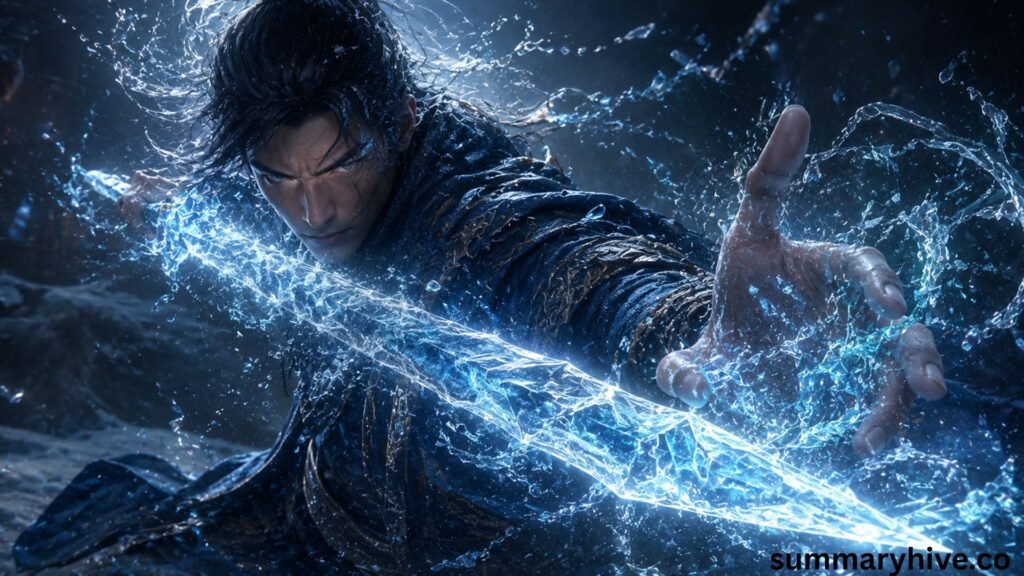
People born with this ability are called jijaka. Each jijaka family tends to specialize in a particular element. The Matsuda family, along with the other warrior houses of Takayubi, wields water and ice magic — pulling water from the air or ground and freezing it into blades, shields, or weapons on command.
The most prestigious technique in the book is the Whispering Blade, a rare mastery-level skill within the Matsuda house’s ice fighting style. Not every family member reaches it. It demands total physical control combined with genuine emotional conviction — the book is clear that raw talent alone is not enough; the fighter’s mindset and motivation matter just as much as their skill.
There’s a second, quieter magical thread running through the story: blood magic, a feared and secretive inheritance tied to Misaki’s side of the family rather than the Matsuda line. Unlike the socially accepted ice-fighting style, blood magic is treated as shameful and “impure” by Takayubi’s traditional culture, which adds another layer to Misaki’s hidden identity — she is carrying a power she can’t openly acknowledge, in a family that would reject her for it.
Beyond Takayubi, the book references other theonite nations and power types, including the Ranga Union military forces who eventually invade, and the distant Yammanka Empire, an allied power with its own theonite traditions. These wider political relationships explain why Takayubi’s isolation is so dangerous: the village believes it’s untouchable, while the rest of the world has moved on without it.
Main Characters: Who’s in The Sword of Kaigen
The Sword of Kaigen Character: Misaki Matsuda
Role & Arc: Misaki is one of the book’s two central point-of-view characters, and arguably its true heart. On the surface, she is a devoted housewife who has spent years suppressing her past. In reality, she trained for years at a demanding foreign academy, mastered real combat, and once lived a life full of ambition and danger. She buried all of it to become the wife Takeru’s family expected. Her arc is about what happens when that buried identity is forced back to the surface by tragedy — she transforms from a silenced, restrained figure into a fierce protector willing to fight, and kill, for what’s left of her family.
The Sword of Kaigen Character: Mamoru Matsuda
Role & Arc: Mamoru is the book’s second POV character, a fourteen-year-old boy raised to see warriorhood as his entire identity. His arc is a coming-of-age story layered on top of a political manipulation plot: he starts the book trusting the empire completely, and ends it understanding that the system he was born into is built on lies. Unlike many of his peers, this knowledge doesn’t make him bitter or passive — it pushes him to act with real courage when the invasion comes, even at enormous cost.
The Sword of Kaigen Character: Matsuda Takeru
Role & Arc: Takeru is Misaki’s husband and Mamoru’s father, the stoic, emotionally closed-off head of the household. For most of the book he represents tradition versus modernity at its most rigid — a man so committed to appearing strong that he refuses to see the danger building around his family or acknowledge his wife’s true self. His arc resolves late, and painfully, when the crisis finally forces him to admit that his coldness was never really strength.
The Sword of Kaigen Character: Kwang Chul-hee
Role & Arc: Chul-hee is the transfer student whose arrival sets the entire plot in motion. He isn’t a warrior by Takayubi’s standards, and that outsider status is exactly what lets him see — and say out loud — what the village has been trained not to question. His friendship with Mamoru is the catalyst for the book’s central theme of truth and propaganda.
Supporting Characters
- Setsuko – Misaki’s sister-in-law and close companion, a source of warmth and steadiness amid the family’s tension.
- Hyori – A young relative of the family whose experience during the invasion becomes one of the book’s most harrowing moments.
- Robin Thundyil – Misaki’s old friend from her academy days abroad, whose reappearance later in the story ties Misaki’s past back into her present.
- Takashi – A Matsuda family member who fights alongside Takeru and Mamoru when the invasion reaches the village.
- Yukino Dai – The village’s swordmaster, respected as one of Takayubi’s most skilled warriors.
- Colonel Song – A Kaigenese military officer whose arrival after the attack exposes just how far the empire will go to protect its official story.
Who Should Read The Sword of Kaigen
This book will likely resonate most with:
- Fans of adult fantasy fiction who want emotional depth alongside action
- Readers who enjoy Japanese inspired fantasy settings and culture-rich world-building
- Anyone drawn to martial arts fantasy and detailed magical combat scenes
- Readers who appreciate stories about family honor and duty and complicated family dynamics
- Fans of war and trauma novel narratives that don’t shy away from real consequences
- People who love a strong warrior mother character rather than a typical young hero lead
- Readers interested in political manipulation in fantasy and propaganda-driven plots
- Anyone who enjoys elemental magic fantasy systems tied closely to character growth
- Book club members looking for a title with rich discussion potential
- Readers who prefer character-driven fantasy over pure plot-driven adventure
It may be a harder fit for readers who want fast-paced, lighthearted escapism, since the second half deals directly with grief, violence, and loss.
If You Liked This, Try These Books
- The Poppy War by R. F. Kuang — another East Asian-inspired epic fantasy book dealing with war and its costs
- She Who Became the Sun by Shelley Parker-Chan — identity, duty, and power in a richly built historical-fantasy world
- The Bone Shard Daughter by Andrea Stewart — political intrigue paired with a unique magic system
- Jade City by Fonda Lee — warrior family dynamics and martial culture at the center of the plot
- The Wolf and the Woodsman by Ava Reid — folklore-rooted fantasy with strong themes of identity and belonging
- Legendborn by Tracy Deonn — a younger protagonist confronting hidden truths about their world
- Daughter of the Moon Goddess by Sue Lynn Tan — another entry in the growing wave of East Asian-inspired fantasy world building
- The Grace of Kings by Ken Liu — sweeping political and military fantasy with deep cultural texture
- Blood Over Bright Haven by M. L. Wang — the author’s next standalone, for readers who want more of her style
- Iron Widow by Xiran Jay Zhao — combat, rebellion, and questioning authority in a fantasy-adjacent setting
Discussion Questions for Book Clubs
- Why does Misaki choose to bury her past for so long, and what finally forces it back to the surface?
- How does Chul-hee’s outsider perspective change the course of the story?
- Do you think Takeru’s transformation at the end feels earned, or too late?
- What does the Whispering Blade symbolize beyond a fighting technique?
- How does the book use government propaganda as both a plot device and a theme?
- In what ways does Mamoru’s arc reflect a loss of innocence versus a gain of purpose?
- How does the novel’s two-part structure affect how you experienced the story’s tension?
- What did the military’s cover-up after the invasion reveal about the empire’s true priorities?
- How do the female characters in the novel navigate power within a rigidly traditional society?
- Would you consider this book’s ending hopeful, tragic, or something in between — and why?
Frequently Asked Questions
What is The Sword of Kaigen about?
It’s an adult fantasy novel about a mother and son in a warrior family who discover that the empire they’ve been raised to defend is built on lies, right as a real invasion threatens their village.
Who is the author of The Sword of Kaigen?
M. L. Wang wrote the novel, originally self-publishing it in 2019.
Is The Sword of Kaigen a standalone book?
Yes. It works completely as a standalone fantasy book, though it shares a universe with Wang’s other Theonite novels.
What is the Whispering Blade?
It’s the Matsuda family’s most prestigious ice-fighting technique, requiring both physical mastery and genuine emotional conviction to achieve.
Does Mamoru die in The Sword of Kaigen?
Yes. Mamoru dies during the Ranganese invasion of Takayubi, after achieving the Whispering Blade for the first time in the same battle.
What is the main theme of The Sword of Kaigen?
The novel’s central themes include truth versus propaganda, family sacrifice, and the tension between tradition versus modernity.
Is The Sword of Kaigen appropriate for younger readers?
No. The book contains graphic violence, war trauma, and mature content, making it best suited for adult and older teen readers.
How does The Sword of Kaigen end?
The village survives the invasion at devastating cost, including Mamoru’s death. Misaki and Takeru finally reconcile honestly, and the family begins rebuilding.
Is The Sword of Kaigen worth reading?
Yes — it’s widely praised for its emotional depth, detailed fantasy world building, and refusal to give easy, uncomplicated answers to its political themes.
What magic system does The Sword of Kaigen use?
Power runs through bloodlines called theonite abilities. The Matsuda family specializes in water and ice magic, with blood magic appearing as a separate, more feared inheritance.
Who are the main characters in The Sword of Kaigen?
The two central characters are Misaki Matsuda and her son Mamoru Matsuda, alongside Takeru, Kwang Chul-hee, Setsuko, and Hyori.
Do I need to read other M. L. Wang books first?
No. The novel is fully self-contained, even though it connects loosely to her other Theonite titles.
What genre is The Sword of Kaigen?
It’s classified as adult fantasy and epic fantasy, with strong martial arts fantasy elements.
How long is The Sword of Kaigen?
The novel runs approximately 650 pages, making it a substantial but immersive read.
Is there a sequel to The Sword of Kaigen?
There is no direct sequel, though it exists within the same universe as Wang’s other Theonite series novels.
About This Guide
This summary was researched directly against the original novel’s text, publisher materials, and multiple independent reader analyses to confirm accuracy on plot events, character details, and the ending. It was written from scratch in original language, avoiding any close paraphrasing of the book’s actual prose, and reviewed for factual consistency before publishing. Our goal is to give readers a genuinely useful reference, not a rehashed summary of what’s already online.
10 Related Article Ideas for Internal Linking
- Blood Over Bright Haven Summary: M. L. Wang’s Next Standalone Explained
- The Theonite Series Reading Order: Where The Sword of Kaigen Fits
- Best Japanese-Inspired Fantasy Novels for Adult Readers
- The Poppy War Summary and Themes Compared to The Sword of Kaigen
- Top Warrior Family Fantasy Books to Read Next
- Misaki Matsuda Character Analysis: A Warrior Mother’s Arc
- Best Adult Fantasy Books With Elemental Magic Systems
- War and Trauma in Fantasy Fiction: How Authors Handle Heavy Themes
- Book Club Guide: Discussing Political Themes in Fantasy Novels
- Self-Published Fantasy Success Stories: How The Sword of Kaigen Found Its Audience
Conclusion
The Sword of Kaigen earns its growing reputation the hard way — not through flashy twists, but through two honest, deeply human arcs wrapped inside a warrior family story that never lets its characters off easy. Misaki and Mamoru’s journeys toward truth cost them everything, and that’s exactly why readers keep recommending this book years after its quiet 2019 release.
Whether you came here for a sword of kaigen chapter summary before book club, a refresher after finishing the novel, or to decide if it’s worth picking up, the answer is the same: this is a martial arts fantasy that respects its readers enough to show real consequences, real grief, and real growth. If themes like truth versus propaganda, family sacrifice, and hard-won reconciliation speak to you, this book belongs on your shelf.