If you just finished As Long as the Lemon Trees Grow and you’re sitting there with a lump in your throat trying to process what happened — or you’re a student who needs a clear, honest summary before class — you’re in the right place. This is one of those books that people finish and immediately go online to talk about, because it doesn’t let you go easily.
As Long as the Lemon Trees Grow is Zoulfa Katouh’s 2022 debut YA historical fiction novel, and it’s not a light read. It follows a young woman named Salama Kassab, a pharmacy student turned emergency medical worker, trying to survive the Syrian Revolution in the besieged city of Homs. It blends real history with a touch of magical realism, a slow-burn romance, and one of the most talked-about plot twists in recent YA fiction.
This guide gives you everything in one place: a spoiler-free summary for people who haven’t finished the book yet, a full spoiler summary for people who want every detail explained, a breakdown of the ending, a full character analysis (including what Khawf actually represents), the book’s major themes and symbolism, and answers to the most common questions readers search for — like what the lemon trees actually symbolize, and whether Layla is real.
Everything here has been checked against the actual text and reliable literary sources, so you’re not getting a generic AI-style summary that could apply to any war novel. This is specific to Salama’s story.
As Long as the Lemon Trees Grow Quick Answer
As Long as the Lemon Trees Grow follows Salama Kassab, a Syrian pharmacy student who becomes a hospital volunteer during the siege of Homs in the early Syrian civil war. Haunted by a hallucination named Khawf (Arabic for “fear”) who urges her to flee, Salama must choose between staying to help her people or escaping to safety with her pregnant sister-in-law, Layla.
Also Read:/well-always-have-summer-summary/
Her growing love for Kenan, a young man documenting the revolution, complicates everything. The novel ends with a dangerous refugee boat crossing and a gutting emotional twist involving Layla.
As Long as the Lemon Trees Grow, Book Overview & Background
As Long as the Lemon Trees Grow is a contemporary YA novel that mixes historical fiction, romance, and magical realism. It’s set in Homs, Syria, beginning in 2011, during the earliest and most hopeful days of the Syrian Revolution — before the world watched it collapse into one of the deadliest conflicts of the century.
Author Zoulfa Katouh was born in Calgary, Canada, to Syrian parents, and she began writing the novel during a NaNoWriMo group in Switzerland in 2017. Katouh works as a pharmacist and scientist alongside her writing career, which is part of why the novel’s hospital scenes and war injuries feel so grounded and specific rather than vague or sanitized.
The book As Long as the Lemon Trees Grow was published in 2022 by Bloomsbury and quickly built a passionate readership. It was a Goodreads Choice Award nominee for Young Adult Fiction and a British Book Award nominee, and in 2023 Katouh won the Amy Mathers Teen Book Award for it. Reception has consistently praised the novel for centering a Syrian refugee story written with lived cultural understanding, rather than treating war-torn Syria as a generic backdrop.
Genre-wise, this book sits at an unusual intersection. It’s shelved as YA historical fiction, but it also carries a war and romance subplot and a speculative fiction element through Khawf — the hallucinated figure who represents Salama’s fear. That combination is part of why the novel resonates with such a wide range of readers: fans of intense survival fiction, fans of emotional YA novels, and readers specifically looking for books about displacement and the refugee journey to Europe.
One thing worth knowing before you start: this is not a comfort read. It deals directly with bombings, a chemical attack, injuries, and death. But it’s balanced with genuine tenderness — humor between siblings, an aching romance, and small moments of joy that Katouh refuses to let the war erase.
Meet the Characters: Who’s in As Long as the Lemon Trees Grow
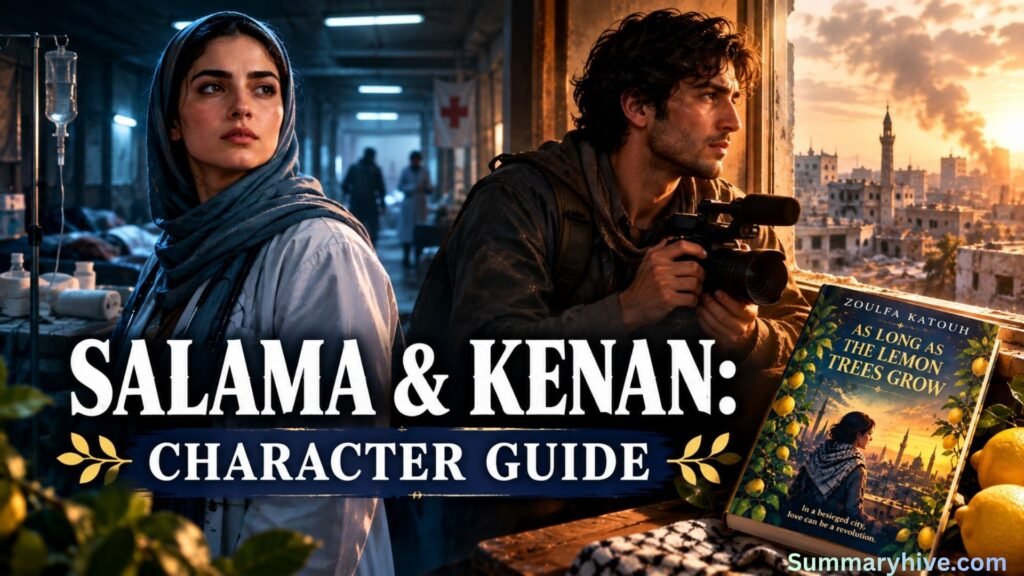
Character: Salama Kassab (also called Salama Alameldeen)
Role & Arc: Salama is the novel’s protagonist and narrator, a twenty-year-old pharmacy student at the outbreak of the revolution. When the hospitals in Homs are overwhelmed, she’s forced into the role of a medical worker, treating gunshot wounds, burns, and the aftermath of bombings despite having no formal medical license. Her arc is built entirely around survival guilt — she wants to leave Syria for safety, but every time she tries, her sense of duty (and her hallucinated companion Khawf) pulls her in different directions. By the novel’s end, she’s forced to confront both her deepest fear and her deepest loss in order to finally choose a future.
Character: Kenan
Role & Arc: Kenan is a young rebel and the novel’s central love interest. Rather than fighting with weapons, he resists by documenting the revolution — filming protests and bombings on his camera and uploading the footage so the outside world can see what’s happening in Homs. He’s caring for his younger siblings, Lama and Yusuf, after their family is fractured by the war. Where Salama is desperate to escape, Kenan initially feels a duty to stay and bear witness. Their relationship becomes the emotional core of the book, and his arc is about learning that survival and hope don’t have to mean abandoning conviction.
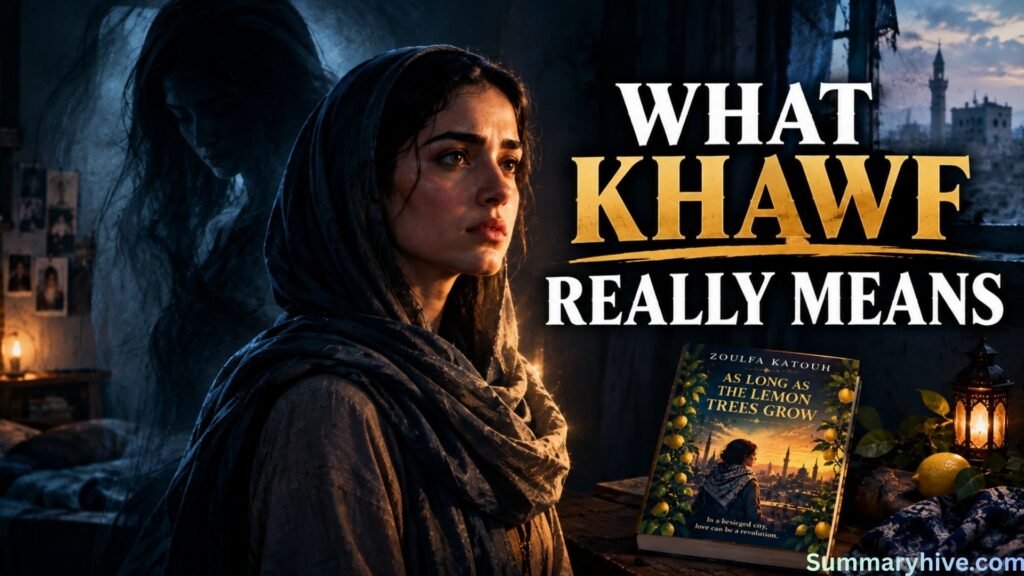
Character: Khawf
Role & Arc: Khawf (Arabic for “fear”) is one of the most discussed elements of the novel — a hallucinated figure only Salama can see. He is not a demon or a literal supernatural entity; he’s a psychological trauma response, the physical embodiment of Salama’s fear and self-preservation instinct. Khawf constantly pushes Salama to leave Syria, using visions of her possible future — both the safety she could have and the horrors she risks if she stays. As the novel progresses, Khawf’s presence shifts, reflecting Salama’s changing mental state, and his role in the story’s ending is central to understanding the novel’s use of magical realism.
Character: Layla
Role & Arc: Layla is introduced as Salama’s pregnant sister-in-law and closest companion, someone she’s determined to get safely out of Syria. Layla provides much of the novel’s warmth — humor, sisterly closeness, and a reason for Salama to keep fighting for a future. Layla’s true nature is connected to the book’s most significant plot twist, discussed in the full spoiler summary below.
Supporting Characters: Hamza, Dr. Ziad, Lama, and Yusuf
- Hamza — Salama’s older brother, who left to fight and whose fate weighs heavily over the family throughout the book.
- Dr. Ziad — The hospital’s lead doctor and Salama’s mentor, representing the older generation’s resolve to keep treating the wounded no matter the cost.
- Lama and Yusuf — Kenan’s younger siblings, whose safety becomes one of the story’s central stakes and gives the romance and the survival plot real emotional weight.
As Long as the Lemon Trees Grow, Plot Summary: Spoiler-Free Version
As Long as the Lemon Trees Grow opens in Homs, Syria, not long after peaceful protests against the government have begun. Salama, once an ordinary pharmacy student with plans for her future, has lost her parents and is now volunteering at a makeshift hospital, treating a constant flow of wounded civilians with skills far beyond her training.
Salama is also haunted by Khawf, a hallucination that pushes her to secure passage out of the country for herself and her pregnant sister-in-law, Layla. Escape isn’t simple — it requires money, forged documents, and trust in smugglers who may not be reliable. While trying to arrange their exit, Salama meets Kenan, a young man documenting the uprising on camera to show the world what’s happening in his city. Their connection grows quickly, complicated by the fact that Kenan is determined to stay and fight for Syria’s future, while Salama is trying to leave it behind.
As the siege of Homs intensifies — bombings, military raids, and eventually a devastating chemical attack — Salama is forced into impossible choices about who she can save, what she owes her country, and what she owes herself. The novel builds toward a harrowing refugee boat journey across the Mediterranean, and a revelation about Layla that reframes much of what came before it.
As Long as the Lemon Trees Grow,Full Plot Summary (With Major Spoilers)
Spoiler Warning: This section reveals major plot points, including the novel’s ending.
The story As Long as the Lemon Trees Grow begins roughly a year into the uprising. Salama, once focused solely on her pharmacy degree, now works alongside Dr. Ziad at an overwhelmed hospital, performing surgeries and treatments no student should have to perform. Her parents are dead, her brother Hamza has gone to fight and hasn’t been heard from, and her only real companion is Layla, her brother’s pregnant wife.
Salama is also visited nightly by Khawf, who shows her both her past losses and possible futures — trying to convince her that survival means leaving. He tells her it will cost $4,000 to get her and Layla safely out of the country, money she doesn’t have.
Everything shifts when Kenan arrives at the hospital desperate for help saving his younger sister, Lama. Salama saves the child’s life, and a bond quickly forms between her and Kenan, who is caring for Lama and his brother Yusuf while filming the protests to send evidence of the regime’s violence to the outside world. Despite Khawf’s warnings that attachment will only make leaving harder, Salama finds herself falling for Kenan and hoping his family might escape with her and Layla.
Their relationship deepens through shared grief and small acts of resistance, including attending a protest together — an act of defiance that nearly gets them both killed when soldiers target a young girl in the crowd. Salama intervenes, is nearly assaulted, and Kenan is badly beaten trying to protect her.
To raise the money needed for passage out of Syria, Salama makes a desperate, morally difficult decision that leaves her shaken — an act she sees as a betrayal of who she thought she was, even though Khawf insists it was necessary for survival. This moment marks a turning point: Salama begins to understand that survival during war rarely comes without cost.
As the situation in Homs worsens — including a chemical attack that fills the hospital with casualties — Kenan finally admits he loves Salama and agrees that his family should leave with her. It’s during this emotionally raw period that Kenan notices something unsettling: Salama sometimes speaks to and looks at someone who isn’t there. She explains Khawf to him.
Then comes the novel’s As Long as the Lemon Trees Grow central twist. When Kenan and his siblings move in with Salama before their planned departure, Kenan cannot see Layla — because Layla has been dead for months. Layla was never physically present; she was a hallucination, just like Khawf, created by Salama’s mind as a way to survive unbearable grief. This revelation recontextualizes nearly every earlier scene involving Layla and reframes the entire novel’s exploration of trauma, psychological survival, and grief.
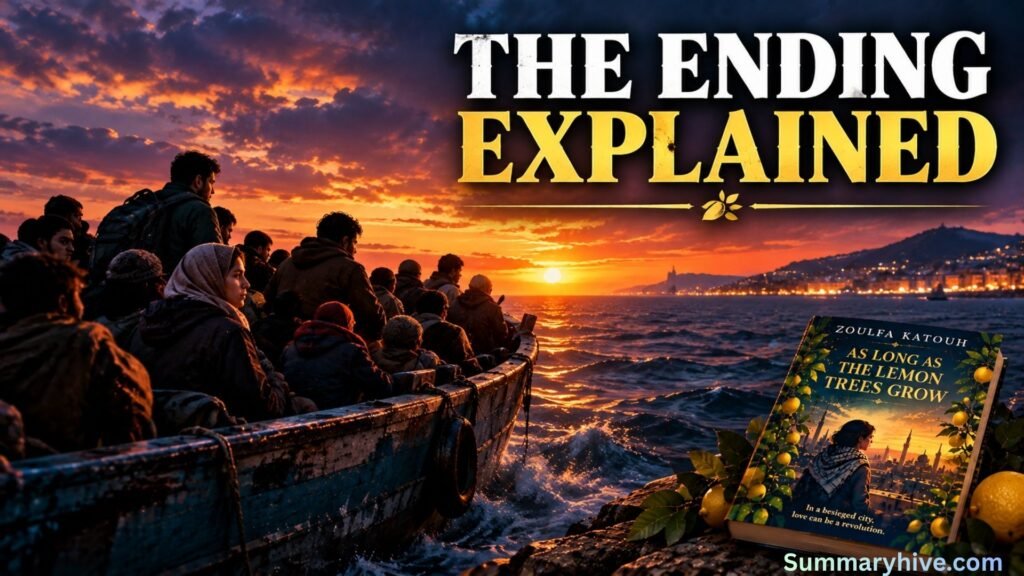
Devastated but finally able to grieve properly, Salama says her goodbyes — including to Dr. Ziad, who stays behind in Homs — and leaves with Kenan, Lama, and Yusuf to meet a smuggler named Am at a mosque. Despite her fear about whether the crossing is safe, there’s no better option left, and the group boards an overcrowded refugee boat bound across the Mediterranean.
During the crossing, Khawf appears to Salama one final time. He tells her that Layla’s death was never her fault — the reassurance she has needed the entire novel — and Salama is finally able to accept it and let go.
How As Long as the Lemon Trees Grow Ends (Ending Explained)
This section fully explains the ending.
The novel As Long as the Lemon Trees Grow closes with Salama, Kenan, Lama, and Yusuf surviving the dangerous sea crossing and reaching safety in Europe, eventually settling in Toronto. This ending matters because it’s genuinely hopeful — a deliberate choice by Katouh, who wanted to give her characters (and her readers) a future, rather than end the story mid-tragedy the way so many real Syrian refugee stories are cut short by the news cycle.
The most important thing to understand about the ending is what it confirms about Khawf and Layla:
- Khawf was never a demon or literal supernatural force. He was always a manifestation of Salama’s fear and trauma response — his warnings, however unsettling, were ultimately about self-preservation.
- Layla’s “death” was a hallucination reveal, not a literal death scene in the story’s present. Layla actually died months before the novel’s main events; Salama’s grief was so severe that her mind created a version of Layla to keep her close. This is the book’s central use of magical realism — using a fantastical element to represent a very real psychological experience: survivor’s guilt and denial as a coping mechanism.
- Khawf’s final appearance, telling Salama that Layla’s death “was not her fault,” represents Salama’s own subconscious finally allowing her to accept the loss and move forward, rather than a literal ghost story resolution.
Many editions of the book also include a bonus short story titled “Joy,” which picks up after the main novel and gives readers a fuller, gentler look at Salama and Kenan’s life together once they’ve reached safety — closing the emotional arc that the main story leaves on a hopeful but still tender note.
As Long as the Lemon Trees Grow, Key Themes Explained
As Long as the Lemon Trees Grow, Survival Guilt and the Cost of Living
One of the novel’s most powerful themes is survival guilt — the psychological weight of staying alive when so many around you haven’t. Salama isn’t a passive victim of circumstance; she’s constantly forced to make active choices about who gets help, who gets left behind, and what she’s willing to sacrifice to secure her own escape. Katouh doesn’t let this guilt resolve neatly. Even Salama’s most defensible decisions leave scars, which is precisely the point: war doesn’t offer clean moral choices, and survival itself can feel like a betrayal of the people who didn’t make it.
As Long as the Lemon Trees Grow, Fear vs. Hope
The entire novel is structured around a tug-of-war between fear (embodied literally by Khawf) and hope (embodied by Salama’s dream of a future, and later by Kenan). Neither force is treated as simply “right.” Khawf’s warnings often keep Salama alive, but they also isolate her from connection and joy. Hope, meanwhile, is shown as something dangerous — falling for Kenan, trusting a future, believing in Syria’s revolution — because hope in a warzone always risks devastating loss. The book argues that surviving requires holding both at once, not choosing one over the other.
As Long as the Lemon Trees Grow, Grief, Denial, and Trauma
Through the Layla twist, Katouh builds an entire narrative around how trauma distorts memory and perception. Layla’s presence throughout most of the book is a portrait of denial as a survival mechanism — Salama’s mind literally refusing to process a loss too large to hold. This ties directly into real conversations around PTSD, hallucination as a trauma response, and how grief doesn’t always look like sadness; sometimes it looks like a mind protecting itself by rewriting reality.
As Long as the Lemon Trees Grow, Duty vs. Self-Preservation
Salama and Kenan represent two opposing responses to the same impossible situation. Kenan feels a duty to document and resist, believing that bearing witness matters even at great personal risk. Salama feels a duty to survive, both for herself and for the people she’s already lost. Their romance becomes the space where these two philosophies are forced to negotiate with each other, rather than one simply winning out.
As Long as the Lemon Trees Grow, Love During Wartime
The romance between Salama and Kenan isn’t a subplot bolted onto a war story — it’s central to the book’s argument that love and joy are acts of resistance, not distractions from suffering. Katouh is careful to show tenderness, humor, and desire existing inside the horror, not despite it, which is part of why readers connect so strongly with their relationship.
As Long as the Lemon Trees Grow, Displacement and the Refugee Experience
The novel’s As Long as the Lemon Trees Grow final act shifts into one of the most emotionally raw refugee stories in recent YA fiction. The Mediterranean crossing isn’t romanticized or rushed — it’s shown as terrifying, uncertain, and a genuine risk to life, grounding the novel’s ending in the very real experiences of the millions displaced by the Syrian civil war.
As Long as the Lemon Trees Grow, Symbolism and Literary Devices
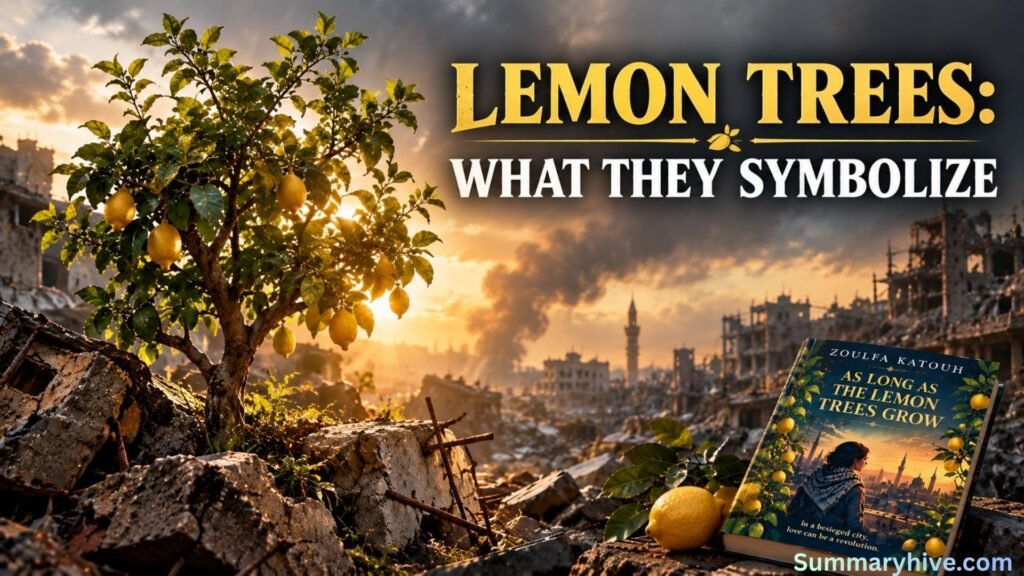
What Do the Lemon Trees Actually Symbolize?
The title comes from a recurring image: characters imagining a future where they can return home and plant new lemon trees. Lemon trees are hardy, slow-growing, and deeply tied to everyday Syrian domestic life — something ordinary, not grand or political. Their symbolism works on two levels:
- Hope for the future — the idea that no matter how much is destroyed, something can be replanted and grown again.
- The stubbornness of ordinary life — small, mundane rituals (a garden, a meal, a home) become quiet acts of resistance against a war trying to erase everything familiar. Choosing to imagine lemon trees, even amid rubble, is Katouh’s way of insisting that normalcy itself is a form of survival.
As Long as the Lemon Trees Grow, Khawf as Symbol, Not Character
It’s worth repeating here because so many readers misunderstand it on a first read: Khawf is a symbol, not a ghost or supernatural entity. He represents fear made visible — and importantly, the author deliberately leaves the Arabic word largely untranslated through much of the book, meaning readers who don’t speak Arabic experience some of the same disorientation Salama does before eventually understanding what — and who — he really is.
As Long as the Lemon Trees Grow, Magical Realism as a Trauma Device
Katouh’s use of magical realism isn’t decorative. Both Khawf and Layla function as literary tools for depicting psychological trauma in a way straightforward prose often struggles to capture. Rather than simply telling readers “Salama is in denial about Layla’s death,” the book shows it, letting readers experience the same confusion and eventual gutting realization that Salama herself goes through.

This is a technique increasingly common in YA war novels and historical YA fiction dealing with trauma, because it mirrors how memory and grief actually behave — non-linear, protective, and often self-deceiving.
As Long as the Lemon Trees Grow, Real Historical Context: Homs and the Syrian Revolution
While As Long as the Lemon Trees Grow is a work of fiction, it’s built on real historical events. The Syrian Revolution began in 2011 as part of the broader Arab Spring, with peaceful protests against the government of Bashar al-Assad. Homs, the novel’s setting, became one of the revolution’s most significant and hardest-hit cities — subjected to prolonged military sieges, heavy bombardment, and documented use of chemical weapons against civilian areas, echoing the chemical attack depicted in the novel.
Katouh has spoken about wanting to honor the Syrian people whose stories were reduced, in international media, to statistics and brief news segments. By grounding Salama’s fictional story in real events — the protests, the siege, the makeshift hospitals overwhelmed by wounded civilians, the dangerous refugee boat crossings to Europe that followed — the novel functions as both a personal story and a work of historical witness, similar in spirit to what Kenan does within the story itself by filming the revolution.
As Long as the Lemon Trees Grow, Common Misconceptions or Misreadings
“Khawf is a real supernatural entity in the story’s world.”
He isn’t. Khawf is confirmed to be a hallucination — a psychological manifestation of Salama’s fear, not a ghost, jinn, or literal force with independent existence.
“Layla’s death happens near the end of the book.”
This trips up a lot of readers. Layla actually died months before the novel’s main events. What happens near the end is the reveal to both Kenan and the reader — not the death itself.
“This is primarily a romance novel.”
While the Salama–Kenan relationship is central and deeply felt, the novel is fundamentally a war and survival story first, using romance as one lens among several (grief, duty, displacement) rather than as the main plot engine.
“The book is purely fictional with no basis in real events.”
The siege of Homs, the chemical attacks, and the refugee crisis depicted are drawn directly from documented events of the Syrian civil war, even though Salama, Kenan, and their specific story are fictional.
Who Should Read As Long as the Lemon Trees Grow
This book will resonate most with readers who want:
- Fans of emotional YA novels that don’t shy away from difficult subject matter
- Readers interested in Syrian war fiction or the Syrian Revolution told from a personal, human perspective
- Anyone who enjoys war and romance novels where the relationship feels earned, not decorative
- Readers who appreciate magical realism used to explore psychological trauma rather than as pure fantasy
- People drawn to books about survival, grief, and resilience
- Readers who want a story centered on Syrian refugees written with cultural authenticity
- Book clubs looking for a discussion-rich, emotionally complex pick
- Anyone who loved character-driven historical YA fiction with a strong sense of place
Sensitivity note: This is not a light or escapist read. It includes graphic depictions of war injuries, a chemical attack, death, and an attempted assault. Readers sensitive to these topics should go in prepared.
Discussion Questions for Book Clubs
- Why do you think Katouh chose to reveal Layla’s true nature the way she did, rather than earlier in the novel?
- Is Khawf a purely negative force in Salama’s life, or does he also protect her?
- How does the novel complicate the idea of “doing the right thing” during war?
- What does the lemon tree symbolize to you personally by the end of the book?
- How do Salama and Kenan’s differing responses to the war — leaving versus staying and documenting — reflect two valid forms of resistance?
- Why might Katouh have chosen to end the novel with hope rather than tragedy?
- How does the novel use magical realism to explore trauma in a way realistic fiction alone might not?
- What responsibility, if any, did you feel Salama had toward the people she couldn’t save?
- How does this novel change or challenge how you think about the Syrian refugee crisis?
- What did the short story “Joy” (if your edition includes it) add to your understanding of Salama and Kenan’s story?
Frequently Asked Questions
What is As Long as the Lemon Trees Grow about?
It’s a YA historical fiction novel about Salama Kassab, a pharmacy student turned hospital volunteer surviving the Syrian Revolution in Homs, who must choose between staying to help her country or escaping to safety.
Who is the author of As Long as the Lemon Trees Grow?
The novel was written by Zoulfa Katouh, a Canadian-Syrian author and scientist, published in 2022 as her debut novel.
Is As Long as the Lemon Trees Grow a true story?
No, the characters are fictional, but the novel is grounded in real historical events, including the siege of Homs, documented chemical attacks, and the wider Syrian civil war and refugee crisis.
Who is Khawf in the book?
Khawf (Arabic for “fear”) is a hallucination only Salama can see. He represents her fear and survival instinct, not a literal supernatural entity.
Is Layla real in As Long as the Lemon Trees Grow?
No. Layla, Salama’s pregnant sister-in-law, is revealed to have died months before the novel’s main events. Salama’s mind created a version of her as a coping mechanism for grief.
How does As Long as the Lemon Trees Grow end?
Salama, Kenan, Lama, and Yusuf survive a dangerous refugee boat crossing of the Mediterranean and reach safety in Europe, eventually settling in Toronto. Salama also finally accepts Layla’s death with help from a final appearance by Khawf.
What does the title As Long as the Lemon Trees Grow mean?
It refers to a recurring dream of returning home to plant new lemon trees, symbolizing hope, renewal, and the persistence of ordinary life even after devastating loss.
Is As Long as the Lemon Trees Grow a romance novel?
It contains a significant romance between Salama and Kenan, but it is primarily a war and survival novel, with romance as one major theme among several.
Is As Long as the Lemon Trees Grow appropriate for younger readers?
It’s marketed as YA (young adult), but it contains graphic war violence, injury, death, and an attempted assault, making it best suited for older teens and adults.
What genre is As Long as the Lemon Trees Grow?
It blends YA historical fiction, contemporary fiction, romance, and magical realism.
Did As Long as the Lemon Trees Grow win any awards?
It was a Goodreads Choice Award nominee for Young Adult Fiction (2022), a British Book Award nominee (2023), and Katouh won the Amy Mathers Teen Book Award for the novel.
What happens to Hamza in the novel?
Hamza, Salama’s older brother, leaves to fight and his fate remains a source of anxiety and grief throughout much of the book.
Is there a sequel to As Long as the Lemon Trees Grow?
As of publication, it stands as a standalone novel, though many editions include a bonus short story titled “Joy” that extends Salama and Kenan’s story after the main ending.
Why doesn’t the author translate the word “Khawf” throughout the book?
Katouh deliberately leaves Khawf untranslated for much of the novel so readers experience some of the same uncertainty Salama does, deepening the impact of the eventual reveal.
Is As Long as the Lemon Trees Grow worth reading?
For readers seeking an emotionally powerful, historically grounded YA war novel with authentic Syrian perspective, complex characters, and a hopeful ending, it’s widely considered a standout in the genre.
Author / Trust Section
This summary As Long as the Lemon Trees Grow analysis were built by reading and cross-referencing the original novel alongside reputable literary sources, published reviews, and reader discussion to ensure factual accuracy about plot, characters, and themes. Every plot detail, character name, and thematic claim in this guide reflects the actual content of As Long as the Lemon Trees Grow by Zoulfa Katouh — nothing has been invented or generalized from similar books. All quoted material has been kept minimal and paraphrased in original language rather than reproduced from the source text, in respect of the author’s work.
Conclusion: Why As Long as the Lemon Trees Grow Stays With You
As Long as the Lemon Trees Grow is not a novel you simply finish and set aside. Zoulfa Katouh built something rare with this book: a story that treats the Syrian Revolution not as a backdrop for drama, but as the lived, devastating reality it was for millions of real people — while still finding room for love, humor, and the stubborn hope of planting lemon trees again someday.
What makes this novel As Long as the Lemon Trees Grow so effective is how tightly its structure serves its message. The magical realism woven through Khawf and Layla isn’t a gimmick; it’s the closest thing prose can offer to showing rather than telling what trauma, grief, and survival guilt actually feel like from the inside. By the time the twist about Layla lands, readers aren’t just shocked — they understand, on a gut level, exactly how far a mind will go to protect itself from unbearable loss. That’s the mark of a writer who trusts her readers enough to let a story’s emotional logic do the heavy lifting instead of spelling everything out.
At its core, this is a book As Long as the Lemon Trees Grow about impossible choices — staying versus leaving, duty versus self-preservation, fear versus hope — and it refuses to pretend any of those choices are simple. Salama and Kenan represent two equally valid, equally painful responses to the same war, and their relationship becomes proof that connection and joy can exist even in the middle of devastation, not despite it but alongside it.
If you’ve read this far, you likely already know this isn’t a book to recommend lightly. It asks a lot of its readers — attention, patience, and a willingness to sit with genuinely difficult material. But for readers drawn to emotional YA novels, historical YA fiction, or stories centering the refugee experience with honesty and cultural authenticity, it delivers something few books manage: a story that honors real suffering without flattening it, and that ends not with despair, but with the quiet, hard-won belief that something can always be replanted.
Whether you’re revisiting the ending, prepping for a book club discussion, or deciding whether to pick it up for the first time, As Long as the Lemon Trees Grow earns its place among the most talked-about YA war novels of its generation.