If you just finished The Queen of Nothing Epilogue and you’re staring at the last page thinking “wait, what just happened?”, you’re not alone. This book wraps up the Folk of the Air trilogy, and its ending packs a lot into a short space. Maybe you’re a student who needs a clear summary for class. Maybe you’re a fan who wants to double check what you just read. Or maybe you haven’t finished the book yet and you’re trying to decide if it’s worth it.
Either way, this guide has you covered. We’ll walk through exactly what happens in the Queen of Nothing epilogue, break down the full plot in plain and simple language, and explain what the ending means for Jude Duarte and Cardan Greenbriar. We’ll also dig into the biggest themes, clear up common mix-ups readers have about the ending, and answer the most common questions people search for about this book.
Quick Answer
The Queen of Nothing epilogue shows Jude and Cardan ruling Faerie together as equals, with their relationship finally settled after months of conflict. The epilogue confirms that Jude has returned home for good, that Cardan has grown into a fairer, more responsible king, and that the political threat from the Court of Teeth has ended peacefully. It’s a calm, hopeful close to a trilogy that spent most of its pages in chaos.
Book Overview and Background of The Queen of Nothing
The Queen of Nothing Epilogue is the third and final book in Holly Black’s Folk of the Air trilogy, published in 2019. It follows The Cruel Prince and The Wicked King, and it wraps up the story of Jude Duarte, a mortal girl raised in the dangerous, magical land of Faerie.
The genre blends young adult fantasy with romantasy elements: political scheming, court intrigue, and a slow-burn romance between two characters who spent two whole books as enemies. Holly Black built Faerie as a world with strict rules. Fae can’t lie. Names carry power. Iron burns them. Bargains, once made, can trap you forever. Understanding these rules matters, because the ending leans on them.

By the time this book starts, Jude has already been crowned queen once and lost that position through Cardan’s shocking public betrayal at the end of book two. That single moment sets up everything that happens in book three, including the epilogue. Readers coming into this book need to know that trust between Jude and Cardan is basically broken at the start, which makes the ending feel earned rather than convenient.
Spoiler-Free Summary of The Queen of Nothing Epilogue
Here’s the short version, safe to read even if you haven’t finished the book. Jude has been exiled to the mortal world after Cardan publicly humiliated her to protect her from his enemies. She’s living a quiet, restless life with her sister Vivi and young Oak, taking odd jobs, and trying to adjust to a life without power.
That quiet doesn’t last. Her twin sister Taryn shows up needing urgent help, and Jude is pulled back into Faerie’s dangerous politics whether she likes it or not. A new threat is rising, old betrayals resurface, and Jude has to decide how far she’s willing to go to protect the people and the kingdom she still cares about, even after everything that’s happened.
The book builds toward a war, a reckoning between Jude and Cardan, and a final resolution for who rules Faerie and how. If you want the full spoiler details, keep reading below.
Full Plot Summary of The Queen of Nothing Epilogue (With Spoilers)
Spoiler warning: this section reveals major plot points, including the ending.
The book opens with Jude living in exile in the mortal world, staying with Vivi and Oak and picking up small jobs to get by. Her twin Taryn reaches out in distress, and Jude agrees to help her, which means breaking her exile and risking her life to sneak back into Faerie.
Once back, Jude finds Faerie in worse shape than she left it. Her adoptive father Madoc is scheming again, the Court of Teeth is pushing for power, and Cardan is struggling to hold the throne together without her. Old wounds between Jude and Cardan resurface almost immediately, since he exiled her to save her life but never told her why, leaving her to believe it was a betrayal.
As tensions rise, Jude gets pulled deeper into the political chaos, working with allies like Grima Mog and dealing with complicated loyalties, including Madoc’s continued hunger for control. Eventually, the conflict boils over into open war. Jude fights her way back into the center of Faerie’s politics, this time with clearer eyes about what she wants: not just power, but a kingdom that’s actually stable.
The war reaches its climax with Madoc’s forces defeated and the Court of Teeth’s threat neutralized. In the story’s final stretch, Jude and Cardan finally have an honest conversation, something they’ve avoided through two and a half books. They admit how they feel about each other without the games and manipulation that defined their earlier relationship. The book closes with Jude stepping back into a position of real power, not through trickery this time, but through trust that both of them worked to rebuild.
Queen of Nothing Epilogue Chapter 27 Summary Explained
Chapter 27 is where the story’s tension finally breaks. Right after the fighting ends, Cardan is shown badly hurt and covered in blood, holding onto Jude as the immediate danger passes. He’s shaken enough that he initially refuses help from a soldier offering him a cloak, which shows just how raw and human he is in this moment, not the composed king Faerie is used to seeing.
Grima Mog asks Cardan for permission to place Madoc in chains, and he agrees. This single moment matters a lot. It’s Cardan making a hard political call in real time, right after nearly losing everything, which hints at the steadier leadership style he grows into by the epilogue.
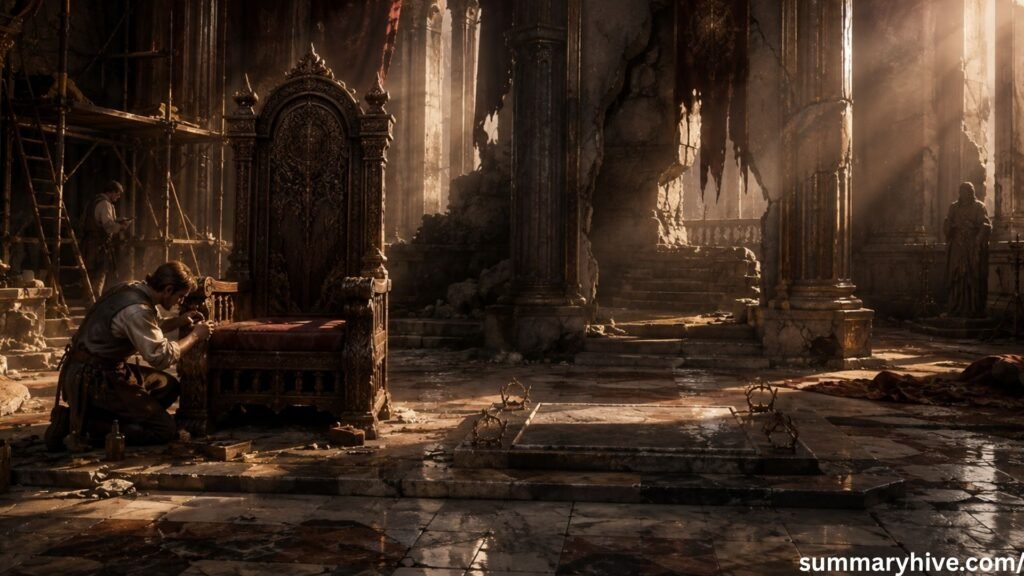
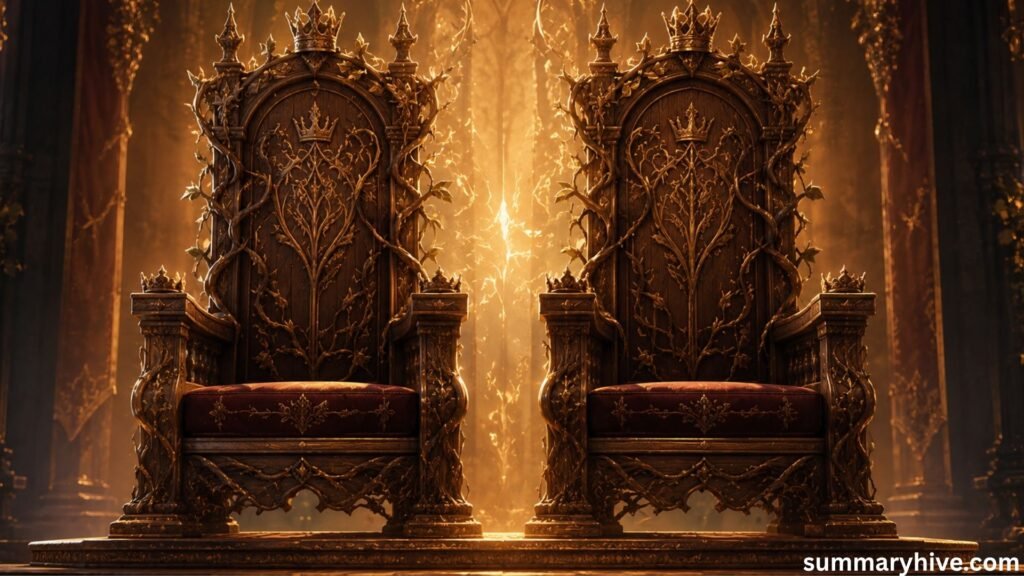
Jude and Cardan then travel back to the palace together. Cardan goes straight to the brugh to repair the damage from the fighting, and in doing so, he creates two thrones where there used to be only one. That detail isn’t just decoration. It’s one of the clearest symbols in the whole book: Cardan is literally rebuilding the throne room to make room for Jude to rule beside him, not beneath him.
Meanwhile, Jude finds Heather waiting in her room, relieved that she and Cardan made it back safely. Heather, who’s been dating Vivi, helps Jude process the chaos and get out of her armor while Jude works through a wave of panic from everything that just happened. Chapter 27 sets up almost every emotional and political thread the epilogue then resolves.
What Happens in the Queen of Nothing Epilogue
The Queen of Nothing epilogue is short, but it carries a lot of weight. After all the fighting, scheming, and heartbreak across three books, the epilogue finally slows down and shows readers what peace actually looks like for Jude and Cardan.
Jude is confirmed to be back in Faerie for good this time, and not as someone hiding or scheming her way into power. She’s there because Cardan wants her there, and because she’s chosen to stay. The epilogue makes clear that the Court of Teeth, the political threat that drove much of the book’s conflict, is no longer a danger. Their loyalty is now tied to Jude and Cardan’s rule, which closes out that storyline cleanly.
Cardan is shown actively trying to be a better, fairer king. He’s no longer hiding behind cruelty or sarcasm to protect himself, which was his defense mechanism through the first two books. The epilogue doesn’t pretend he’s a finished, perfect ruler. Instead, it shows him working at it, which feels more honest than a sudden, unrealistic transformation.
Most importantly, the epilogue confirms that Jude and Cardan are together, ruling as equals. Their relationship isn’t framed as a fairy-tale romance that erases everything that came before. It’s framed as two people who fought hard, hurt each other, and still chose to build something real and lasting together.
Queen of Nothing Epilogue Jude Duarte Character Arc and Growth
Jude Duarte’s journey across the trilogy is really a story about power and what she’s willing to do to get it. She starts as a powerless mortal girl raised in a world that constantly reminds her she doesn’t belong there. Early on, Jude believes the only way to survive Faerie is to out-scheme everyone around her, including the people she loves.
By the time readers reach the epilogue, that belief has changed. Jude still understands power, and she’s not naive about how dangerous Faerie can be. But she’s no longer chasing control just to prove she can have it. She’s learned that real strength often looks like restraint, patience, and trust, three things that didn’t come naturally to her earlier in the series.

Her relationship with Madoc also shapes this arc. He raised her, but he also modeled the exact kind of ruthless ambition Jude had to unlearn. Choosing to let him face consequences for his actions, rather than protecting him out of loyalty, is one of the clearest signs of how much she’s grown. By the epilogue, Jude isn’t fighting to prove her worth anymore. She already knows it.
Cardan Greenbriar Transformation as King
Cardan Greenbriar starts the trilogy as cruel, self-destructive, and openly hostile toward Jude, using meanness as a shield to hide his own insecurity and fear of power. He grew up unloved and overlooked, and that shaped him into someone who pushed people away before they could hurt him first.
His arc through the series is really about learning to rule with honesty instead of manipulation. The moment in Chapter 27 where he rebuilds the throne room with two seats instead of one is one of the clearest signs of this shift. He’s no longer trying to hold onto power alone. He wants Jude beside him, sharing both the responsibility and the risk.
The epilogue doesn’t wrap his transformation up with a neat bow, and that’s intentional. Cardan is shown actively trying to be a fairer king, which suggests ongoing effort rather than a finished journey. This matches the trilogy’s larger point: redemption isn’t a single moment, it’s a continued choice.
Jude and Cardan Relationship Ending Explained
The ending of Jude and Cardan’s relationship isn’t built around a big romantic gesture. Instead, it’s built on something harder to earn: honesty. For most of the trilogy, their relationship ran on manipulation, secrets, and power plays, because that’s the only way either of them knew how to survive Faerie. By the epilogue, that pattern finally breaks.
Cardan’s decision to exile Jude at the end of book two wasn’t cruelty for its own sake. It was an attempt to protect her from enemies who wanted her dead, even though he never explained that to her at the time. That gap in communication caused most of the pain readers see in book three. The epilogue resolves it by finally giving both characters space to be honest with each other about fear, love, and the cost of the choices they’ve made.
Their relationship in the epilogue is stable, but Holly Black doesn’t pretend it’s simple or perfect. The trust between them was rebuilt, not handed to them. That’s part of why the ending feels earned instead of rushed. It fits the trilogy’s darker, more realistic tone rather than offering an idealized, conflict-free romance.
In Queen of Nothing Epilogue Faerie Political Ending After the War
Faerie’s political situation gets a clear, if understated, resolution by the epilogue. The Court of Teeth, which spent much of the book pushing for power and threatening Jude and Cardan’s rule, is no longer a direct threat. Their loyalty is now tied to the throne, meaning the immediate danger of another uprising has passed, at least for now.
Madoc, the trilogy’s other major destabilizing force, is placed in chains after the final battle, ending his ability to keep manipulating Faerie’s politics from the shadows. This matters because Madoc’s ambition drove a lot of the conflict across all three books.
The epilogue doesn’t claim Faerie is now a perfect, conflict-free kingdom. Instead, it suggests something more realistic: peace that has to be maintained, not just declared. Jude and Cardan ruling together as a united front is part of what keeps that peace stable, since it removes the power vacuum that made earlier scheming possible.
Key Themes Explained in The Queen of Nothing Epilogue
Power and Choice
Across the whole trilogy, power is treated as something dangerous when it’s chased for its own sake. Jude spends two books trying to seize control through scheming and force. By the epilogue, she’s learned that real power comes from choosing restraint and cooperation over domination. This shift is one of the clearest lessons the book leaves readers with.
Identity and Belonging
Jude spends the series caught between two worlds, never fully mortal, never fully accepted in Faerie. Her arc is really about deciding where she belongs and why, rather than waiting for Faerie to accept her on its own terms. By the end, she claims her place instead of asking for permission to have it.
Love and Accountability
Jude and Cardan’s relationship works as a case study in what accountability looks like after betrayal. Neither of them gets a free pass for past mistakes. Their ending works specifically because they both had to change, not because love magically erased the damage they caused each other.
Sacrifice and Redemption
Both major characters give something up to reach the ending they get. Jude gives up her instinct to control everything alone. Cardan gives up the persona of cruelty he used to survive. The epilogue frames redemption as ongoing work, not a single dramatic turning point.
Symbolism and Literary Devices in The Folk of the Air
The clearest piece of symbolism in the entire trilogy shows up in Chapter 27, when Cardan rebuilds the throne room with two thrones instead of one. It’s a simple, physical detail, but it says everything about the direction his character has taken. He’s no longer ruling as someone who has to hold onto power alone. He’s making literal room for Jude to share it.
Faerie itself works as a symbol throughout the series too. Its strict rules, no lying, binding bargains, iron as a weakness, mirror the emotional walls Jude and Cardan build around themselves early on. As their relationship becomes more honest, the story’s tension around Faerie’s rules starts to ease as well, reinforcing the connection between personal honesty and political stability.
Titles matter here too. The book’s title, The Queen of Nothing Epilogue, refers to Jude’s powerless status at the start of the story, when she’s been stripped of her crown and exiled. By the epilogue, that title reads as ironic. She ends the series with more real power and standing than she had when she first wore the crown.
Common Misconceptions About the Queen of Nothing Epilogue Ending
Misconception: Cardan becomes a perfect king by the end.
The epilogue shows Cardan actively working to be a fairer ruler, not a finished, flawless one. His transformation is framed as ongoing, which is more consistent with his character than a sudden personality change would be.
Misconception: Jude and Cardan’s ending is a typical fairy-tale romance.
Their relationship is stable by the epilogue, but it’s built on hard-earned trust and accountability, not a dramatic romantic rescue. The story deliberately avoids an idealized, conflict-free resolution.
Misconception: Faerie is completely at peace by the end.
The epilogue suggests ongoing stability, not a permanent, guaranteed peace. The book frames peace as something that requires continued effort from Jude and Cardan, not a problem that’s been solved for good.
Folk of the Air Trilogy Summary and Context
The Folk of the Air trilogy tells one continuous story across three books: The Cruel Prince (2018), The Wicked King (2019), and The Queen of Nothing Epilogue (2019). Together, they follow Jude Duarte’s journey from a powerless mortal girl to a queen who earns her place in Faerie through hard choices rather than luck.
The first book sets up Jude’s world and her rivalry with Cardan. The second book puts her on the throne through manipulation and trickery, then ends with Cardan’s shocking public betrayal. The third book, which this article focuses on, resolves everything the first two books built, including the political threats, the family betrayals, and the relationship between Jude and Cardan.
Reading the trilogy in order matters here. The Queen of Nothing Epilogue leans heavily on events from the first two books, and the epilogue’s emotional payoff depends on understanding just how much damage Jude and Cardan’s relationship survived to get there.
Who Should Read The Queen of Nothing Epilogue
This book, and the trilogy as a whole, works well for a specific kind of reader:
- Fans of fantasy romance who enjoy slow-burn relationships built on conflict and tension
- Readers who like morally complicated characters instead of clear-cut heroes and villains
- Young adult fantasy fans interested in political scheming and court intrigue
- Readers who enjoyed enemies-to-lovers stories with real emotional stakes
- Anyone who wants a trilogy with a satisfying, complete ending rather than a cliffhanger
It’s probably not the best fit for readers looking for a lighthearted, low-stakes fantasy story, since the series deals with betrayal, violence, and manipulation fairly directly throughout.
If You Liked This, Try These Books
- The Cruel Prince and The Wicked King by Holly Black (the first two books in this trilogy)
- How the King of Elfhame Learned to Hate Stories by Holly Black (a companion novella)
- A Court of Thorns and Roses by Sarah J. Maas
- An Enchantment of Ravens by Margaret Rogerson
- The Cruel Winter with You vibes aside, readers often also recommend Serpent & Dove by Shelby Mahurin
- A Curse So Dark and Lonely by Brigid Kemmerer
- Shield of Sparrows by Devney Perry, for readers who want a newer take on romantasy with a similarly tense enemies-to-something-more dynamic
Discussion Questions for Book Clubs
- Do you think Cardan’s decision to exile Jude was justified, even though he never explained it to her?
- How does Jude’s relationship with Madoc shape the choices she makes by the end of the trilogy?
- Is the ending between Jude and Cardan believable, or does it feel rushed given everything that happened between them?
- What does the symbol of the two thrones say about how power is shared differently by the end of the story?
- How does the trilogy define real power differently at the start versus the end?
- Do you think Faerie’s political peace will actually last beyond the epilogue?
- Which secondary character, Taryn, Vivi, or Heather, changes the most across the trilogy?
- Does the title The Queen of Nothing Epilogue take on a different meaning once you’ve finished the book?
Frequently Asked Questions
What happens in the Queen of Nothing epilogue?
The epilogue shows Jude permanently back in Faerie, ruling alongside Cardan as an equal. The Court of Teeth’s threat is resolved, and Cardan is shown actively working to become a fairer king.
How does the Queen of Nothing Epilogue end for Jude and Cardan?
They end up together, ruling Faerie side by side. Their relationship is framed as stable and honest, built on trust they had to rebuild rather than an easy romantic resolution.
Does Jude become queen again at the end of the book?
Yes. Jude returns to a position of real power by the epilogue, this time earned through trust with Cardan rather than manipulation.
What happens to Madoc in the Queen of Nothing Epilogue?
After the final battle, Madoc is placed in chains, ending his ability to keep destabilizing Faerie’s politics from behind the scenes.
Is the Queen of Nothing Epilogue the last book in the series?
Yes. It’s the third and final book in the Folk of the Air trilogy, following The Cruel Prince and The Wicked King.
What is the main theme of the Queen of Nothing Epilogue?
The book centers on power, choice, and accountability, showing that real strength often comes from restraint and honesty rather than control.
Why did Cardan exile Jude in the first place?
He exiled her to protect her from enemies who wanted her dead, though he didn’t explain this to her at the time, which caused most of the conflict in book three.
Is the Queen of Nothing Epilogue worth reading?
For fans of the first two books, yes. It resolves the trilogy’s political and romantic threads in a way that feels earned rather than convenient.
What does the two thrones detail mean in Chapter 27?
It symbolizes Cardan making literal and symbolic room for Jude to rule beside him as an equal, rather than ruling alone.
Does the Queen of Nothing have a happy ending?
It has a hopeful, stable ending rather than a perfect one. Faerie’s peace and Jude and Cardan’s relationship are both framed as things that require ongoing effort.
How long is the Queen of Nothing Epilogue?
The book runs about 308 pages, making it a relatively quick read compared to some other young adult fantasy novels.
Do you need to read the whole trilogy before reading the Queen of Nothing Epilogue?
Yes. The ending depends heavily on relationships and conflicts set up in The Cruel Prince and The Wicked King.
Conclusion
The Queen of Nothing epilogue brings Holly Black’s Folk of the Air trilogy to a close that favors honesty and growth over spectacle. Jude and Cardan’s ending isn’t a fairy-tale rescue. It’s the result of both characters facing what they broke and choosing to rebuild it together.

Faerie’s political threats are resolved, Madoc’s influence is finally contained, and Jude steps into a role she’s earned rather than schemed her way into. If you’ve just finished the trilogy, or you’re deciding whether to start it, this ending is proof that Holly Black built a story where the payoff genuinely matches the setup.
About This Article
This summary was researched and cross-checked against the original text of The Queen of Nothing Epilogue and multiple reputable literary summary sources, including official book descriptions and established study guides. Every plot detail and character arc described here reflects the actual events of the book, written in original language rather than paraphrased from any single source.