
Imagine hearing strange scratching sounds behind your bedroom wall every night. Your father says it is only mice, so he brings home a kitten to help. But the noises keep coming. Now imagine the truth is far more dangerous than mice. Behind that wall, two people are hiding for their lives, and if anyone finds out, your whole family could be arrested.
That is the shocking starting point of Behind the Bedroom Wall, a young adult historical fiction novel by Laura E. Williams, first published in 1996. The story is set in Nazi Germany in 1942, at a time when the Nazi regime was hunting down Jewish families across the country. It follows Korinna Rehme, a 13-year-old German girl who proudly belongs to the Jungmädel, a Nazi youth group for girls. She has been taught to love Adolf Hitler, repeat patriotic slogans, and look down on Jewish people. Then she learns that her own parents are hiding a Jewish mother and daughter in a secret room in her home.
If you are searching for a Behind the Bedroom Wall summary, you probably have one of a few goals. You might be a student who needs help with a book report or a class test. You might be a parent or teacher checking if the book is right for a young reader. Or you might simply be curious about how the story ends before you start reading. This guide is built to help with all of these.
Here is the short answer. The book Behind the Bedroom Wall is about a girl who has been fed Nazi propaganda her whole life and must choose between what she was taught and what she now sees with her own eyes. She can turn her parents in to the Gestapo, or she can protect the hidden family. Her choice, and the way she changes, is what the whole story is about.
In this article Behind the Bedroom Wall, you will find a quick answer, a spoiler-free summary, and a full plot summary with the ending explained. You will also get simple character notes, the main themes and symbols, the historical context of the Holocaust, discussion questions, study questions, and answers to the questions people ask most.
Everything is written in plain, easy words, so readers of any age can follow along. We have also checked the details against trusted reviews and publisher descriptions, so you can rely on what you read here.
Quick Answer: What Is Behind the Bedroom Wall About?
Behind the Bedroom Wall is a 1996 novel about a 13-year-old German girl named Korinna Rehme in Nazi Germany in 1942. Korinna loves Hitler’s youth group until she discovers her parents are hiding a Jewish mother and daughter behind her bedroom wall. As she gets to know them, her beliefs change, and she must decide whether to turn her parents in or protect the hidden family. In the end, a Gestapo raid forces her to act fast, and her choices show how courage and compassion can beat Nazi propaganda.
Behind the Bedroom Wall at a Glance
Here are the key facts in one place. They are easy to scan and useful for a book report.
| Detail | Information |
|---|---|
| Title | Behind the Bedroom Wall |
| Author | Laura E. Williams |
| Genre | Young adult historical fiction |
| Year published | 1996 |
| Setting | Germany, 1942, during World War II |
| Main character | Korinna Rehme, age 13 |
| Point of view | Told through Korinna’s eyes, close to her thoughts |
| Main conflict | Loyalty to Nazi beliefs versus loyalty to family and to doing what is right |
| Suggested reading age | Roughly grades 5 to 8 |
| Main subjects | Holocaust, Nazi propaganda, moral choices, courage |
The book is short and quick to read, so many teachers use it to introduce Holocaust education to younger students. It shows big, hard events through the eyes of one girl. This makes the history easier to understand, but it is still serious. Adults may want to talk about it with younger readers.
What Happens in the Book (Behind the Bedroom Wall)? (Spoiler-Free Summary)
The story begins in Nazi Germany in 1942. Korinna Rehme is a proud member of the Jungmädel. She goes to meetings with her friends, learns the group’s slogans, and truly believes that Adolf Hitler is helping Germany. She has also learned to look down on Jewish people, because that is what her teachers and youth leaders say every day.
Also Read:/its-not-summer-without-you/
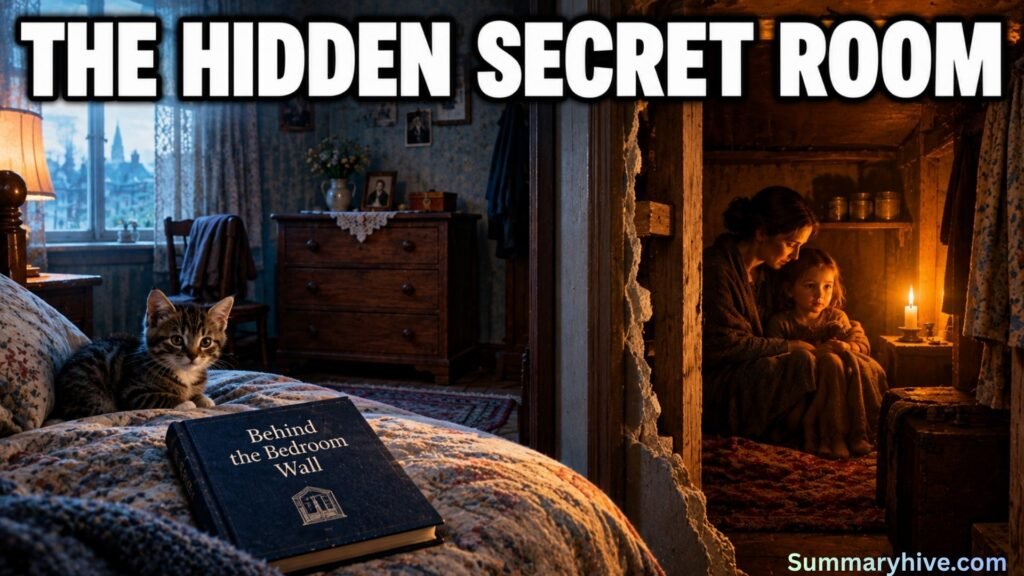
At home, though, odd things keep happening. Korinna hears strange noises in her room at night. Her father says it must be mice. Soon, Korinna finds the real reason for the sounds, and it turns her world upside down. Her parents have been keeping a big secret from her, one that could put the whole family in danger.
Korinna now faces a scary choice. Should she tell someone in authority, as her youth group has taught her to do? Or should she keep the secret and protect the people she loves? The choice gets harder when her best friend Rita starts to notice that something is wrong. Rita’s family has a link to the Gestapo, so even a small mistake could be deadly.
From here the story becomes a tense mix of fear, suspicion, and secret-keeping. Korinna must decide who she really is, and who she can really trust. If you want to know exactly how it all turns out, jump ahead to the full summary with spoilers in the next section.
Behind the Bedroom Wall, Historical Context: Nazi Germany in 1942
You do not need to be a history expert to enjoy this book. Still, a little background makes the story much more powerful.
In 1933, Adolf Hitler and the Nazi regime took control of Germany. They blamed Jewish people for the country’s problems. This was anti-Semitism, which means hatred of Jewish people. Step by step, the government took away Jewish people’s rights. In 1935, new laws stopped Jewish people from being full citizens. In 1938, mobs burned synagogues and smashed Jewish shops in a night of violence often called Kristallnacht. Later, Jewish people were forced to wear yellow stars on their clothes so everyone could spot them.
By 1942, the situation was terrible. Jewish families were being taken from their homes and sent away to ghettos and camps. Millions would be murdered in what we now call the Holocaust. Ordinary Germans lived under fear and repression. The Gestapo, the secret police, watched for anyone who spoke against the government. People who helped Jewish families could be arrested, sent to prison, or worse.
Even so, a small number of brave people hid Jews anyway. They are often called rescuers, and some are honored as “Righteous Among the Nations.” They hid families in attics, cellars, and behind false walls. The Rehme family in this novel is a made-up example of these real-life heroes. The book is fiction, but it is based on the kind of courage and survival that really happened.
Who Were the Jungmädel? The Nazi Youth Group Explained
The Jungmädel is one of the most important ideas in the book, so let’s make it clear.
The Nazi youth movement wanted to shape every child in Germany. Boys joined the Hitler Youth. Girls joined the League of German Girls. The younger girls, around ages 10 to 14, were placed in a section called the Jungmädel. That name means “Young Girls.”
On the surface, the group looked like a fun club. Girls went on hikes, played sports, sang songs, and did crafts. They got uniforms, badges, and a strong feeling of belonging. That is why so many children joined and enjoyed it. But the real goal was propaganda and brainwashing. Leaders taught girls to worship Hitler, to repeat patriotic slogans, and to see Jewish people as enemies. Children were even encouraged to report neighbors, teachers, or family members who seemed “un-German.”
This is why Korinna’s situation is so painful. Her club is her whole social world, and it has taught her to see her own parents as possible traitors. When she starts to doubt the group, she is not just changing her mind about an idea. She is risking her friends, her place in school, and her safety.
Some critics say the book makes the youth group look one-sided and does not show why so many children truly liked it. As you read, remember that real young people had many different feelings about these groups. Korinna’s story shows just one path.
Behind the Bedroom Wall Plot Summary (Full Summary With Spoilers)
Spoiler warning: This section explains the whole story, including the ending. If you want to read the book first, skip to the next section.
Behind the Bedroom Wall Full Summary (With Spoilers)
The story Behind the Bedroom Wall starts in 1942 Germany. Korinna Rehme, age 13, is a loyal member of the Jungmädel. She loves her meetings, believes Nazi propaganda, and thinks Jewish people are a danger to Germany. She even watches her Jewish neighbors get attacked and taken away without feeling sorry for them.
At night, Korinna keeps hearing scratching sounds behind her bedroom wall. Her father tells her it is only mice and gives her a kitten to solve the problem. But the sounds do not stop. When Korinna finally investigates, she moves the large piece of furniture in her room and finds a secret room hidden behind it. Inside are two Jewish people in hiding: a mother named Sophie Krugmann and her young daughter, Rachel.

Korinna is horrified. Her parents, she learns, belong to an underground organization that helps Jewish refugees escape. To Korinna, that makes them traitors. She is torn between telling someone, as her youth group has taught her, and keeping quiet to protect her mother and father. She stops sleeping well, skips school, and acts strangely.
Over time, something surprising happens. Korinna starts to see Sophie and Rachel as real people, not as the “enemies” from the slogans. She notices Sophie’s tiredness and sadness. She grows fond of little Rachel, even though she tries to fight that feeling. Meanwhile, she sees how cruel the Gestapo really is. Neighbors and even a teacher are arrested. Her old beliefs begin to crack.
All this time, Korinna’s best friend Rita senses that something is wrong. Rita’s brother works for the Gestapo, so her suspicion is truly dangerous. Rita begins to watch the Rehme family closely, and the trouble builds toward a night Gestapo raid on the house.
When the officers arrive, Korinna has to think fast. Her quick thinking helps save Sophie and Rachel from being found. It is the moment when she finally chooses her family and her conscience over the Nazi ideas she once believed. But the Rehmes can no longer stay safe at home. They are forced to flee, and the family that once hid others now has to hide too.
Behind the Bedroom Wall Ending Explained
How does Behind the Bedroom Wall end? The book ends with a Gestapo raid, Korinna’s brave quick thinking, and the Rehme family running away to stay safe. Korinna helps save the hidden Jewish mother and daughter, but she and her parents must go into hiding themselves.
Here is why the ending matters.
It shows Korinna’s change is complete. At the start, she would have reported anyone who seemed “un-German.” By the end, she risks her own life to protect Sophie and Rachel. She has moved from fear and obedience to moral courage.
It flips the hiding theme. For most of the book, the Rehmes protect others. In the last part, the Rehmes become the ones who need protection. This shows that hiding Jews was not a small act. Helpers paid a heavy price, and they lived with the same fear as the people they saved.
It refuses an easy happy ending. The family is safe for now, but nothing is fixed. The war goes on, and the danger has not gone away. This is realistic. Real rescuers did not get to relax when one raid was over.
It connects to the author’s message. In her afterword, Laura E. Williams suggests that freedom may matter even more than love. Some reviewers found that idea a little unclear in the story itself. Still, the ending makes one point clearly: doing the right thing can cost you a lot, and people can choose to do it anyway.
How the Story Builds: Four Stages of the Plot
You may see the phrase Behind the Bedroom Wall chapter summary in search results. Since editions can differ, this guide breaks the plot into four easy stages instead. This is handy for study notes and book reports.
Stage one is the loyal girl. Korinna is proud of the Jungmädel, trusts Hitler, and enjoys her life. The strange noises in her room are the first small crack in her happy picture.
Stage two is the discovery. Korinna finds the hidden room and meets Sophie and Rachel. She feels shock, anger, and fear. This stage is full of suspicion and secrets.
Stage three is the struggle. Korinna wrestles with her moral dilemma while her feelings slowly change. Rita’s suspicion grows, and the danger around the family rises.
Stage four is the raid and escape. The Gestapo comes, Korinna acts, and the Rehmes flee. This is the story’s peak and its finish.
Main Characters in Behind the Bedroom Wall
The book has a small cast, so it is easy to keep track of everyone. Here are the key people and how they change.
Behind the Bedroom Wall, Korinna Rehme

Role and arc: Korinna is the heart of the book, and the story is told through her point of view. She begins as a proud, loyal Nazi youth who repeats slogans she does not fully understand. When she learns the truth about her parents, she goes through anger, fear, and confusion. Slowly, through her time with Sophie and Rachel, she learns to think for herself. By the end she is brave, kind, and ready to take a stand. Her change is called Korinna’s transformation, and it is the main lesson of the book.
Behind the Bedroom Wall, Sophie Krugmann
Role and arc: Sophie is the Jewish mother hiding in the secret room. She is tired, worried, and sometimes bitter, which is very understandable after living in fear. She does not try to be a hero. She only wants her daughter to survive. Through Sophie, readers see how hard Jewish persecution was for ordinary families.
Behind the Bedroom Wall, Krugmann
Role and arc: Rachel is Sophie’s young daughter, about five years old. She is cheerful and sweet, and she is the first person to soften Korinna’s heart. Rachel shows that Nazi ideology was wrong: she is simply a little girl, nothing like the “enemy” in the propaganda.
Behind the Bedroom Wall, Herr Rehme and Frau Rehme
Role and arc: Korinna’s father and mother are quiet heroes. From the outside, they look like an ordinary German family. In secret, they are part of the underground resistance. They lie to their own daughter to keep everyone safe, which is painful for all of them. Their love for Korinna, and their courage, guide her toward the right choice.
Behind the Bedroom Wall, Rita
Role and arc: Rita is Korinna’s best friend and a devoted member of the youth group. Her brother works for the Gestapo, which makes her a source of danger. Rita shows what happens when a person fully believes propaganda. She is not written as a monster, but her suspicion and betrayal threaten everyone. Her friendship with Korinna is tested more than any other.
Behind the Bedroom Wall, Eva
Role and arc: Eva is another friend from Korinna’s circle. She plays a smaller role, but she helps show how normal and friendly the youth group looked on the surface.
Key Themes in Behind the Bedroom Wall Explained
A theme is the big idea a story wants you to think about. This book has several strong ones. Here is each theme, how it shows up, and why it matters.
Behind the Bedroom Wall, Propaganda and Brainwashing
The most important theme is how Nazi propaganda can shape a child’s mind. Korinna does not hate Jewish people because she has met any and disliked them. She hates them because teachers, leaders, and slogans told her to. She repeats patriotic slogans without really thinking about them.
Why it matters: The book shows that propaganda and brainwashing work best on people who never stop to ask questions. Today’s readers can use the same lesson whenever they hear a message repeated over and over, at school, online, or anywhere else.
Moral Dilemma and Crisis of Conscience
Korinna faces a moral dilemma with no easy answer. If she turns her parents in, she follows the rules she was taught, but she would probably destroy her family. If she keeps quiet, she protects the people she loves, but she breaks every rule she has ever believed in. This kind of crisis of conscience drives the whole plot.

Why it matters: The book teaches that real choices are often hard. Doing the right thing may cost you friends, safety, or comfort.
Trust and Deception
Almost everyone in the story is hiding something. Korinna’s parents lie to her. Korinna lies to her friends. Rita quietly watches and plots. Nobody can fully trust anybody. The theme of trust and deception explains why life under the Nazi regime felt so scary: even your own home was not fully safe.
Why it matters: The book shows that fear and secrets can poison even the closest relationships.
Compassion and Changing Beliefs
Korinna’s beliefs do not change because someone wins an argument. They change because she spends time with Sophie and Rachel and sees them as real people. Her compassion for Jews grows slowly, against her own wishes. This is the moral awakening at the center of the book.
Why it matters: The story suggests that prejudice often falls apart when people actually get to know one another.
Family Loyalty and Friendship
Korinna is pulled between her family loyalty and her friendship with Rita. Both feel strong and real. In the end, she chooses her family and her conscience. Her friendship with Rita, however, becomes a story of betrayal and suspicion.
Why it matters: The book asks readers what loyalty truly means. Is it following your group, or standing by what you know is right?
Courage, Fear, and Survival
Nearly every character feels fear, but some act anyway. The Rehmes show quiet courage by hiding a family day after day. Sophie shows courage by simply staying alive. Korinna shows courage in the final raid. The book says that courage does not mean having no fear. It means acting while you are afraid.
Freedom and Morality
In her afterword, the author suggests that freedom can matter even more than love. Reviewers have noted that this idea is not developed as strongly in the story itself as other themes. Still, the book keeps returning to the point that people under a harsh government lose their freedom to speak, think, and choose. Doing right often means using what freedom you have left.
Behind the Bedroom Wall, Symbolism and Literary Devices
The bedroom wall. The wall is in the title, so it clearly matters. It separates the “safe” life Korinna knows from the hidden truth next to her. A wall can also stand for the way propaganda blocks people from seeing the truth. When Korinna finds what is behind it, her old view of the world is broken open.
The secret room. This small hidden space stands for both protection and prison. It saves Sophie and Rachel’s lives, but it also means they can barely move, speak, or breathe freely. It shows how forced hiding takes away ordinary human life, even when it saves people from something worse.
The mice and the kitten. Korinna’s father blames the noises on mice and gives her a kitten to deal with the problem. This is a cover story. The “mice” are a small lie that hides a huge truth. It also shows how good people sometimes must deceive in order to protect others.
Slogans and the youth group uniform. The slogans Korinna repeats are like a script she has memorized. The uniform stands for belonging, but also for giving up your own thinking. As Korinna changes, she moves away from repeating what others say and toward speaking for herself.
Light and darkness. Many scenes happen at night, in secret, or in cramped hidden spaces. This helps build suspense and fits the theme of good versus evil without spelling it out.
Literary Devices to Know
Point of view. The story is told from Korinna’s side, close to her thoughts. Because we see everything through a girl who starts out believing propaganda, we feel her confusion and slowly learn the truth along with her.
Foreshadowing. The strange noises early in the book hint that something is hidden long before Korinna finds out. Rita’s small questions also warn us that danger is coming.
Irony. It is ironic that Korinna’s youth group teaches girls to spot “traitors,” while the biggest “traitors” turn out to be her own kind, brave parents.
Suspense and pacing. The chapters are short and the plot moves fast, which makes the book easy to finish quickly.
Korinna’s Moral Dilemma and Transformation
Korinna’s change is the reason the book exists, so it deserves a closer look. It does not happen all at once. It moves through steps.
First, shock and anger. Korinna sees her parents as breaking the rules of the country she loves. She feels betrayed by them, which is a twist: she is the one who has been misled, but she feels lied to.
Second, fear and confusion. She knows what her youth group says she should do. She also knows what happens to people the Gestapo takes away. She cannot sleep, she skips school, and she starts to act oddly.
Third, small human moments. Rachel’s cheerfulness and Sophie’s exhaustion make it hard for Korinna to keep believing the slogans. Each little scene chips away at her old ideas.
Fourth, the choice. When the raid comes, Korinna must act in an instant. She has no time for slogans. Her quick thinking helps protect the hidden family, and this proves she has changed for real.
This journey is why the book is often described as a coming-of-age story. Korinna grows up not just by getting older, but by learning to think for herself.
Common Misconceptions About Behind the Bedroom Wall
A few ideas about this book come up again and again, and some are wrong. Here is a quick fix for each.
“It is a true story.” It is not. It is historical fiction. The characters are made up, though the setting and the dangers are based on real history and on real people who hid Jewish families.
“Korinna’s parents are Nazis.” No. They only look like an ordinary German family. In secret, they work with an underground organization to help Jewish people escape.

“Rita is just a villain.” Rita is better understood as a girl who fully believes what she was taught. Her tie to a Gestapo brother makes her dangerous, but she also shows how propaganda can turn a friend into a threat.
“Sophie is the daughter.” Some short reviews mix up the names. Sophie Krugmann is the mother, and Rachel is her young daughter.
“Korinna changes her mind quickly.” She does not. Her change is slow, uneven, and full of doubt, which makes it feel more believable.
“The ending is happy.” It is hopeful but not simple. The hidden family is saved for now, but the Rehmes have to flee, and the war is far from over.
“Korinna is 11.” One review says so, but most sources say she is 13, and that is the age used in this guide.
Critical Reception: What Do Reviewers Say?
The book Behind the Bedroom Wall has drawn mixed but interesting reactions. Looking at both sides helps you decide if it is right for you.
Praise first. Booklist wrote that readers will be caught up by the courage of the rescuer family and by how Korinna changes as she gets to know the Jewish family as people, and it called the ending tense. School Library Journal noted that the mood and atmosphere of the time feel real, and it pointed to Korinna’s quick thinking during the raid. Kirkus Reviews praised the author for honoring the courage and cleverness of ordinary people in dark times, and said the story shows the Gestapo’s cruelty in a quiet way instead of lecturing.
Now the criticism. Publishers Weekly felt the novel was heavy-handed and leaned on melodrama over real conflict. It argued that the book does not explore why the youth groups appealed to so many children, and that it turns hard choices into simple good-versus-evil ones. Kirkus also found the afterword’s idea about freedom and love a bit confusing.
A fair summary: The book is not a deep historical study. Its strengths are its short length, fast pacing, and clear message. That makes it a strong first book about the Holocaust for young readers, though older readers may want more complexity. Pairing it with memoirs or other nonfiction gives a fuller picture.
Who Should Read Behind the Bedroom Wall? (And What to Read Next)
This book Behind the Bedroom Wall is a good fit for students in roughly grades 5 to 8, teachers introducing Holocaust education, parents looking for a first World War II story, and book clubs who enjoy historical fiction. It reads fast, the language is simple, and the message is clear.
You may want to wait or read along with a child if the young reader is sensitive to scary themes. The book includes arrests, violence against Jewish neighbors, and constant fear.
If you liked this book Behind the Bedroom Wall , try these next. Number the Stars by Lois Lowry follows a Danish girl who helps protect her Jewish friend. The Diary of a Young Girl by Anne Frank is the real diary of a girl hiding from the Nazis. Friedrich by Hans Peter Richter shows Nazi Germany through a boy whose Jewish neighbor is slowly pushed out of society.
The Devil’s Arithmetic by Jane Yolen sends a modern girl back in time to the Holocaust. For older readers, The Book Thief by Markus Zusak tells a longer, deeper story about a German girl during the war. The Publishers Weekly review also points readers toward the memoirs Mischling, Second Degree by Ilse Koehn and I Was There by Hans Peter Richter, which show the range of feelings young people had about the youth groups.
Discussion Questions for Book Clubs
These questions work well for a class, a family, or a book club.
- Why did Korinna believe what her youth group taught her? Have you ever believed something just because everyone around you did?
- Korinna’s parents lied to her for her own safety. Was that fair? What else could they have done?
- What was the first moment you saw Korinna’s feelings start to change?
- Why do you think Rachel was the first person to reach Korinna’s heart?
- Is Rita a bad person, or a girl who believes what she was taught? Explain your view.
- Would you have had the courage to act as Korinna did during the raid?
- The hiding place saved lives but also trapped people. What does that tell us about life under the Nazi regime?
Behind the Bedroom Wall, Study Guide Questions (With Short Answers)
1. Where and when does the story take place? In Germany in 1942, during World War II and the Holocaust.
2. What is the Jungmädel? A Nazi youth group for younger girls, part of the wider Nazi youth movement.
3. What does Korinna find Behind the Bedroom Wall? A secret room where Sophie Krugmann and her daughter Rachel are hiding.
4. Why is Rita dangerous to the Rehmes? She becomes suspicious, and her brother is tied to the Gestapo.
5. What is the main conflict? Korinna must choose between the beliefs she was taught and loyalty to her family and her conscience.
6. How has Korinna changed by the end? She goes from a loyal believer in Nazi ideology to a brave young person who protects the hidden family.
7. Essay prompt: How does the author use the bedroom wall and the secret room to show ideas about truth and safety?
Frequently Asked Questions
What is Behind the Bedroom Wall about?
It is about a 13-year-old German girl named Korinna Rehme in 1942 who discovers her parents are hiding a Jewish mother and daughter behind her bedroom wall. She must decide whether to turn them in or protect them.
Who wrote Behind the Bedroom Wall?
Laura E. Williams wrote Behind the Bedroom Wall . It was first published in 1996. Her earlier novel The Long Silk Strand came out in 1995.
Is Behind the Bedroom Wall a true story?
No. It is historical fiction. The characters are invented, but the setting and dangers reflect real events, including real families who hid Jewish people.
How does Behind the Bedroom Wall end?
A Gestapo raid forces Korinna to think fast, and her actions help save the hidden family. The Rehmes then have to flee to stay safe.
Who is the main character?
Korinna Rehme, a 13-year-old member of the Jungmädel. The story follows her as she learns to think for herself.
Who are Sophie and Rachel Krugmann?
Sophie is the Jewish mother and Rachel is her young daughter. They are the hidden family in the secret room.
What is the main theme of the book?
The main theme is how propaganda shapes people and how compassion and courage can help someone break free from it. Moral choice, trust and deception, and family loyalty are also big themes.
Why is the book called Behind the Bedroom Wall?
The hidden family lives in a secret room behind the wall of Korinna’s bedroom. The title also hints at the “wall” of lies and propaganda that Korinna must see past.
What age is Behind the Bedroom Wall for?
It is usually recommended for about grades 5 to 8. Parents should know it includes scary themes such as arrests and persecution.
Is Behind the Bedroom Wall worth reading?
Yes, if you want a short, fast, easy-to-read introduction to life in Nazi Germany and the idea of standing up for what is right. Some critics find it simple and one-sided, so older readers may want additional books for a fuller view.
Is there a sequel?
As far as I know, it is a stand-alone novel. Check the author’s official page or your library for the latest information.
Why did Korinna change her mind?
Getting to know Sophie and Rachel as real people, and seeing the Gestapo’s cruelty up close, slowly broke down what she had been taught.
About This Guide: Research and Editorial Approach
This guide was built by cross-checking the plot and character details against publisher descriptions and professional reviews from Booklist, School Library Journal, Kirkus Reviews, and Publishers Weekly, along with a study-guide overview. Everything is written in original words. The guide does not copy the book’s text or the competitor pages.
Where sources disagreed, such as Korinna’s age, this guide notes the difference and uses the most widely reported detail. Small details can vary between editions, so readers should confirm specifics against their own copy. If you spot an error, please report it so it can be corrected
Conclusion
In 1942 Nazi Germany, Korinna Rehme starts out as a loyal member of the Jungmädel. She believes the slogans she hears and trusts the leaders who tell her what to think. Then she discovers that her parents are hiding Sophie Krugmann and her young daughter Rachel behind her bedroom wall. From that moment, her simple world falls apart. She feels angry, scared, and confused. She lies awake at night, and she has to decide whether to obey the rules she was taught or protect her family and the people in hiding.
Step by step, Korinna changes. She gets to know Sophie and Rachel as real people, not as the “enemies” from Nazi propaganda. She sees the cruelty of the Gestapo with her own eyes. When a night raid comes, she finally acts on her own conscience, and her quick thinking helps save the hidden family. The Rehmes then have to flee, and the family that once hid others must now hide too. The ending is hopeful, but it is not easy or perfect, and that is what makes it feel real.
The book’s main lessons are clear and easy to remember. Propaganda and brainwashing can shape how a child thinks. Compassion often grows when people get to know one another. Courage means doing the right thing even when you are afraid. And moral choices can cost a lot, but they are still worth making.