If you just finished Isles of the Emberdark or you’re trying to decide whether to pick it up, you probably have one simple question: what actually happens in this book? Brandon Sanderson’s newest Cosmere novel is long, layered, and packed with new terms like the emberdark, Shadesmar, and Investiture, and it connects to an older story called Sixth of the Dusk.
That mix of new world-building and old continuity can make the plot hard to follow, especially if this is your first trip into Sanderson’s shared universe.This guide exists to make that easier. Below, you will find a clear Isles of the Emberdark summary that walks through the story from the opening scenes to the final chapter, along with breakdowns of the main characters, the magic system, the biggest themes, and the ending.
Whether you are catching up before a book club meeting, writing a book report, or simply want a refresher on who Dusk and Starling are before your next Sanderson read, everything you need is organized here in one place.
We built this article by comparing the actual events of the novel against the most detailed existing summaries and reviews, then organizing that information the way a reader actually searches for it: quick answers first, full detail after. You will not find filler here — every section is written to answer a specific question real readers ask about this book.
Quick Answer
Isles of the Emberdark follows Sixth of the Dusk, a former bird trapper from the deadly island of Patji, and Starling, a young dragon trapped in human form by magical manacles, as their two very different worlds collide.
Dusk sails into a mysterious dark dimension called the emberdark to find a way for his people to survive contact with a technologically advanced alien empire, while Starling searches that same dark expanse for a way to save her ship’s crew and, eventually, herself. Their paths cross on a remote island guarded by an ancient, god-touched creature, and their combined choices reshape the future of both their peoples.
Book Overview and Background
Isles of the Emberdark is a fantasy science fiction novel by Brandon Sanderson, published in 2025 as part of his Cosmere universe — the same interconnected setting behind series like Mistborn and The Way of Kings. Unlike those earlier series, this book takes place much further along in the Cosmere’s timeline, in an era where magic and technology exist side by side and interplanetary travel through starships is possible.
The novel began life as a much shorter story. Back in 2014, Sanderson published a novella called Sixth of the Dusk, which introduced the character Dusk and his island home. Isles of the Emberdark expands that novella into a full-length standalone Cosmere story, folding the original novella in as flashback chapters while building an entirely new plot around it. It was released under Sanderson’s now-famous Secret Project branding, following the surprise Secret Project 5 announcement, and quickly became one of his most talked-about recent releases.
Readers do not need to have read Sixth of the Dusk first. The novel reintroduces everything a new reader needs: Dusk’s world, his history with Aviar birds, and the dangers of his home island. That said, longtime Cosmere fans will notice this book answers questions that have lingered since 2014, particularly around what happens to Dusk’s people after their first encounter with outsiders.
At its core, this is a story about two very different kinds of survival. Dusk is fighting to keep his small island culture from being erased by a more powerful outside force. Starling is fighting to reclaim a piece of herself that was taken away twelve years earlier. The book uses those two personal stories to explore much bigger ideas about colonialism themes, technological progress, and what it actually means to adapt without losing who you are.
Isles of the Emberdark Spoiler-Free Summary
For readers who have not finished the book yet, here is what you need to know without any major reveals.
Isles of the Emberdark opens with Sixth of the Dusk living a quiet, almost defeated life. He was once the last great trapper of Aviar — magical birds that grant powers to the humans who bond with them — on Patji, a dangerous island so deadly it kills most people who set foot on it. Now, Aviar are mass-produced instead of hand-trapped, and Dusk spends his days giving tired presentations to schoolchildren instead of risking his life on the island he knows better than anyone alive.
That quiet life ends when Dusk’s people, the Eelakin, come under pressure from a second group of alien visitors demanding loyalty. Using a vision from his Aviar companion Sak, Dusk realizes his people are running out of time to prove they can stand on their own. His answer is to sail into the emberdark, an endless, dark, ocean-like dimension few people have ever explored, in search of something that could change his people’s fate.
At the same time, in a completely different part of the Cosmere, a young dragon named Starling — trapped in human form and unable to use her true abilities — is serving on a ragtag cargo ship crewed by outcasts. When her crew stumbles onto a map pointing toward a rare and valuable location, Starling makes a desperate bet that could either free her crew from their financial troubles or cost her fifty years of servitude.
Dusk and Starling’s stories eventually converge on a remote, heavily guarded island, where both must confront a monstrous creature and a manipulative colonial officer in order to get what they came for. What follows is a story about leadership and sacrifice, finding a new purpose, and the price of freedom — for a person, and for an entire people.
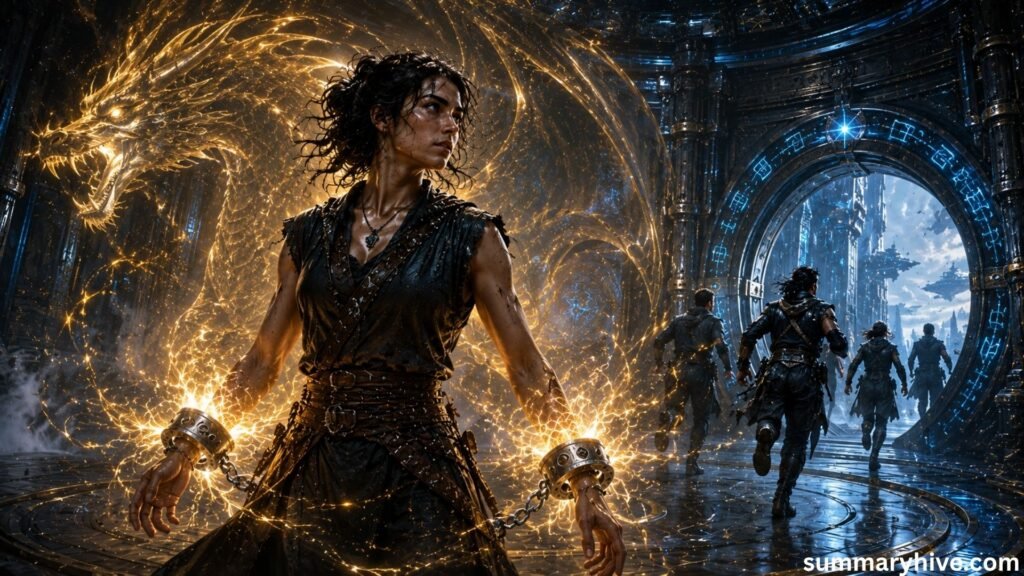
Isles of the Emberdark opens with a prologue set fifty-seven years before the main story, showing Starling as a young dragon experiencing her first transformation under her uncle Frost, an ancient dragon. Dragons spend their first three decades in human form to learn empathy before gaining the ability to shift freely between shapes. In the present, Starling has been exiled from her kind and locked in human form for twelve years by magical silver manacles.
In the present timeline, Dusk is a man without purpose, giving bored presentations at a heritage park instead of trapping Aviar on Patji. He still carries Sak, a rare bird whose talent shows him visions of his own corpse as warnings of danger, while his other companion Kokerlii died two years earlier in a plague. Flashback chapters reveal how, five years prior, Dusk rescued a company clerk named Vathi from one of his traps and crossed Patji with her at night, fleeing nightmaws — massive predators that hunt by sensing minds.
Together they discovered that Aviar powers come from glowing parasitic worms living in a sacred pool at Patji’s Eye, and that the alien Ones Above, humans from the planet Scadrial, had deliberately planted advanced technology as a trap meant to justify a future invasion.
Back in the present, Vathi has become president of the Eelakin’s governing body. When a second alien faction arrives demanding allegiance, Sak shows Dusk an unprecedented vision: not his own death, but Vathi’s, dressed as a defeated colonial governor. Dusk and Vathi realize Patji’s sacred pool is actually a perpendicularity — a rare portal connecting the Physical Realm to Shadesmar, the Cognitive Realm where interplanetary travel moves far faster than normal space. Beyond that portal lies the emberdark, an endless dark plane with no landmarks.
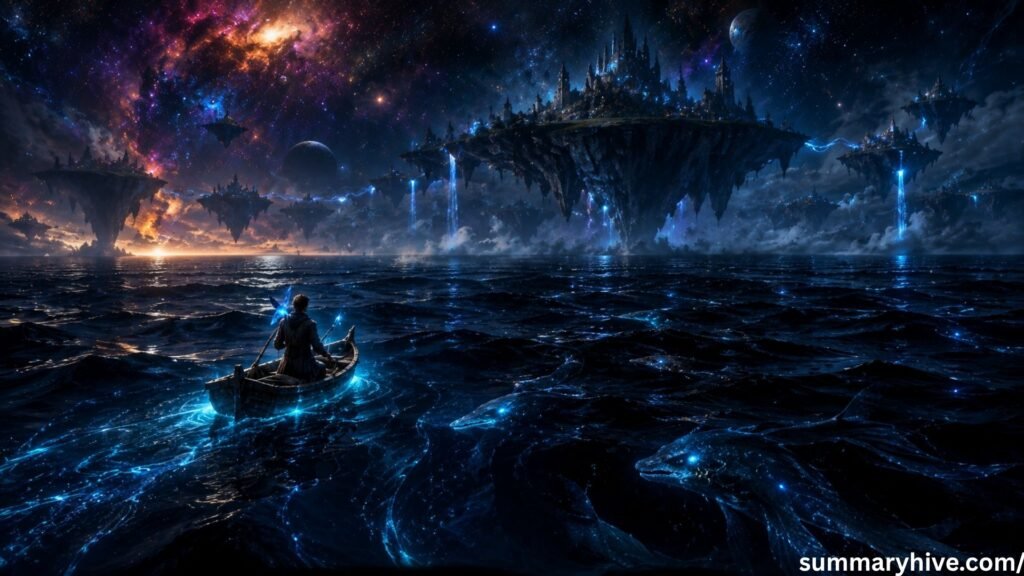
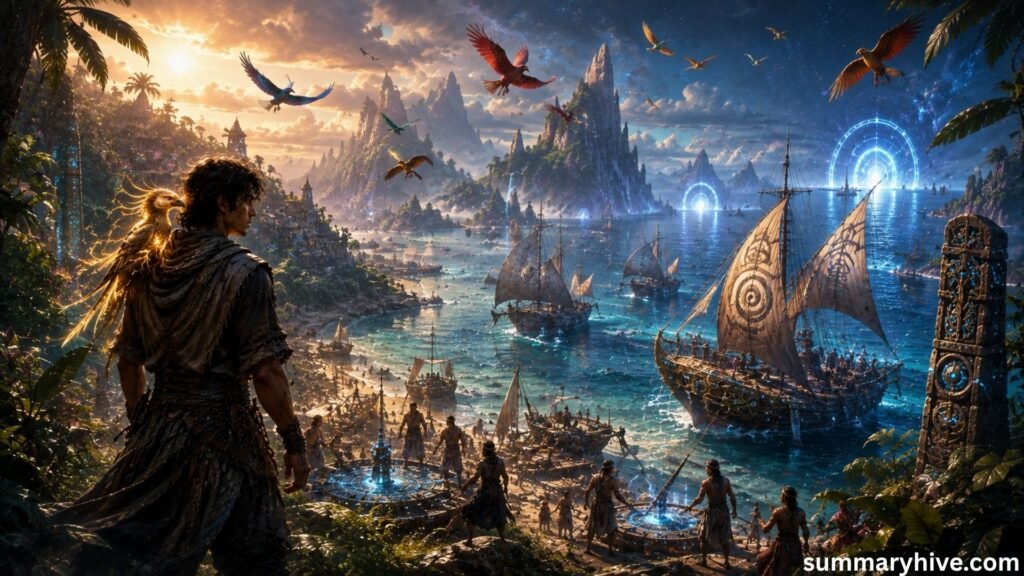
Dusk sails into it alone, coating his small boat in glowing worm paste so it can float on the emberdark’s surface, hoping to prove his people can chart their own future.
Meanwhile, Starling serves as first officer aboard the Dynamic, a patchwork cargo ship crewed by outcasts assembled by their absent captain, Hoid. After the crew defies interim captain Crow to rescue a stranded family, they receive an ancient map pointing to a perpendicularity on the planet the Scadrians call Drominad, known locally as First of the Sun. Starling wagers with the ship’s dragon-owner, Xisis, that she can confirm the location within six months — or serve him for fifty years.
Alone in the emberdark, Dusk survives for weeks by hunting eyeless predators he names skullsnakes. Eating worm paste lets him sense the Current, a pulse of energy radiating from a distant landmark called the Knell, and he becomes a Navigator, able to feel land, creatures, and distance the way island navigators read waves. Three weeks in, he finds an island held by Malwish Scadrian soldiers under Colonel Dajer, guarding a massive entity called the Dakwara — a serpentine being shaped over centuries by Eelakin storytelling from a fragment of a dead god.
Starling’s ship arrives at the same island, and Dajer forces the crew to land, capturing the crew member Nazh and locking the rest in a habitat pod. He pressures Starling into a service contract by threatening her crew, dangling a device called the Intensifier that could free her manacles. Dajer then sends Dusk and Starling into a tunnel filled with dangers that mirror Dusk’s original crossing of Patji — the cave is a manifestation of Investiture, shaped by his own memories. In a vision, Dusk witnesses Cakoban, the legendary Eelakin navigator, sacrifice himself to bind the entity to this island long ago.
The crew hatches an escape plan: if Starling can get Dajer to overdraw the Intensifier’s power, the resulting blackout will disable the camp’s locks. During the process, Starling has a vision of Hoid, who tells her to stop protecting her crew alone and start leading them. At the climax, she signs Dajer’s contract and goads him into firing the Intensifier at full power — then, as her draconic strength surges and freedom is within reach, she deliberately feeds her own energy back into the manacles rather than break them, choosing her crew’s escape over her own liberation. The blackout hits, and the crew breaks free.
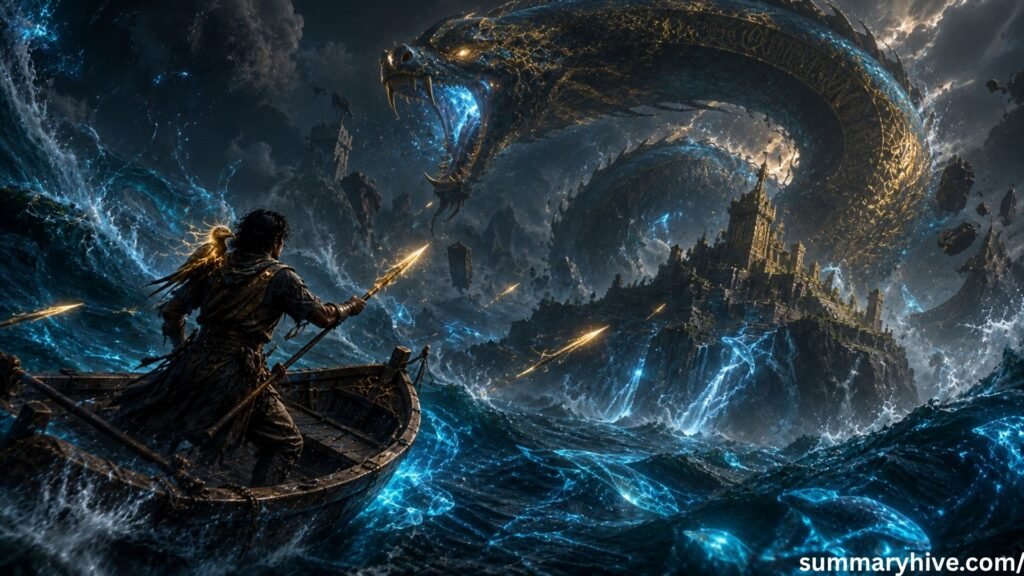
At the same moment, Dusk challenges the Dakwara directly, using speared skullsnakes to tow his boat through its moat at speed. Reaching the inner island, he finds Cakoban’s remains alongside writing signed by Frost, proving the Eelakin once navigated the emberdark and were allied with dragons. The Dakwara submits to Dusk’s service for a century. When Dajer’s gunship fires on the fleeing Dynamic, Dusk commands the Dakwara to destroy it, killing Dajer but sparing the surrendering soldiers.
Dusk leads Starling back through the perpendicularity onto First of the Sun, where Vathi meets them. Dusk proposes a new path for his people: instead of selling Aviar, the Eelakin will sell something no other civilization has — the ability to navigate the emberdark — making them valuable partners instead of conquest targets. In an epilogue six months later, the first trained Navigators complete a successful voyage, Dusk hands control of the Dakwara to the presidency rather than keeping it himself, and joins the Dynamic’s crew as its Navigator. The crew commits to their next mission: freeing Starling from her manacles for good.
World-Building Explained: The Emberdark, Shadesmar, and Patji
One reason Isles of the Emberdark feels different from earlier Cosmere books is its setting. Sanderson blends fantasy adventure story elements with genuine science fiction elements, and understanding a few key locations makes the plot much easier to follow.
Patji is the deadly island where Dusk grew up trapping Aviar. It is filled with poisonous plants, nightmaws, and other lethal wildlife, and at its center sits Patji’s Eye, a sacred pool where glowing worms that grant Aviar their powers can be found. This island is also the site of a perpendicularity, a rare point where the physical world touches a parallel dimension.
That parallel dimension is Shadesmar, also called the Cognitive Realm — a mirror version of reality shaped by belief and thought rather than solid matter, which Sanderson has used across multiple Cosmere books. Within Shadesmar lies the emberdark, a specific, enormous region shown for the first time in this novel: an endless dark plane with a transparent, walkable surface and no fixed landmarks, making it both a mysterious portal to reach and nearly impossible to navigate once you’re inside.
Traveling through Shadesmar is dramatically faster than traveling through normal space, which is why both Dusk and the crew of the Dynamic are drawn to it — for Dusk, it’s a way to find his people a future; for Starling’s crew, it’s a potential fortune. A distant landmark called the Knell anchors part of the region, emitting a pulse of energy called the Current that trained Navigators can read like ocean waves.
Magic System Explained: Aviar Powers and Investiture
The Cosmere’s magic systems are built on a single underlying force Sanderson calls Investiture — the raw magical energy that powers everything from dragon shapeshifting to Aviar bonds. In Isles of the Emberdark, Investiture shows up in two major forms.
The first is the Aviar powers system. Aviar are ordinary-looking birds that gain magical abilities after eating glowing parasitic worms found in specific sacred pools, such as the one at Patji’s Eye. Once a bird has eaten the worms, a human can bond with it to gain access to its power — Sak’s ability to show visions of danger, or Kokerlii’s ability to cloak a person’s mind from predators, are both examples. For generations, Eelakin trappers like Dusk risked their lives gathering wild Aviar on Patji; by the present day, powers-granting worms have been identified and Aviar are mass-produced instead, which is part of why Dusk feels his old skills have become obsolete.
The second major form is draconic shapeshifting, tied to Starling’s storyline. Dragons in the Cosmere spend their first thirty years locked in human form specifically so they develop empathy for mortal beings before gaining the ability to transform. Starling’s silver manacles are an artificial version of that same restriction, magically forcing her to remain human long after her natural transformation should have occurred — which is why removing them becomes such high-stakes personal stakes throughout the book.
By the novel’s climax, a third concept enters the picture: the tunnel Dajer forces Dusk and Starling through is described as Investiture shaped directly by Dusk’s own memories, showing that in the Cosmere, magic can be influenced by belief and personal history, not just physical rules.
Isles of the Emberdark Characters
Isles of the Emberdark Character: Sixth of the Dusk
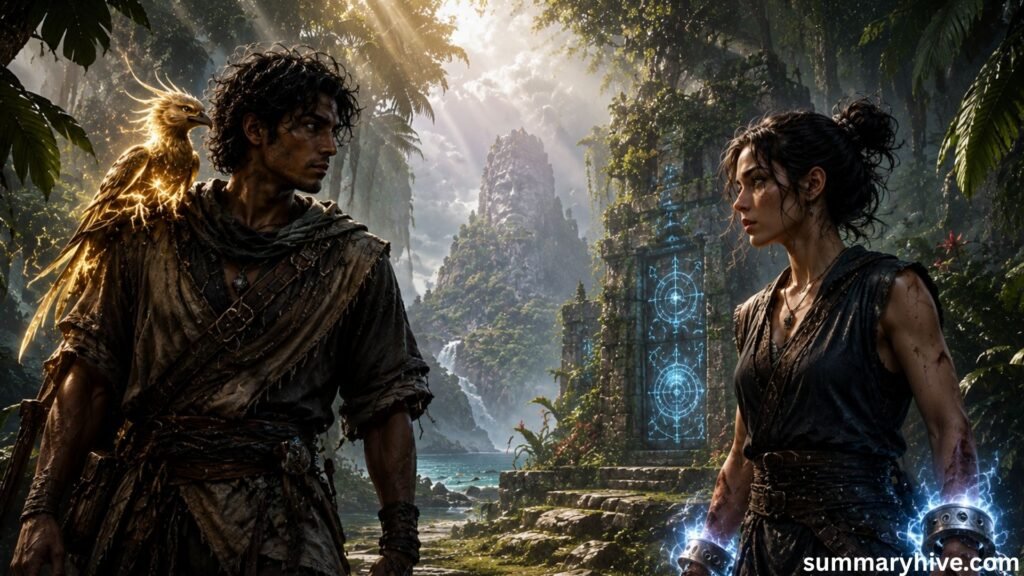
Role & Arc: Dusk is the story’s primary protagonist, a former Aviar trapper who begins the book feeling obsolete and purposeless now that his old skills have been replaced by industrial Aviaries. Over the course of the novel, he rediscovers his value by becoming the first modern Navigator of the emberdark, and his arc resolves around leadership and sacrifice — he ultimately chooses to hand control of the powerful Dakwara over to a democratic institution rather than keep that power for himself, showing how far he has grown from the isolated trapper we meet at the start.
Isles of the Emberdark Character: Starling (Illistandrista)
Role & Arc: Starling is a young dragon trapped in human form by magical silver manacles, serving as first officer on the Dynamic. Her arc is about learning to lead rather than simply protect; guided by a vision of Hoid, she moves from quietly shouldering her crew’s burdens alone to openly admitting uncertainty and trusting them to act together. Her defining moment comes when she sacrifices her own chance at freedom to save her crew instead, cementing finding a new purpose as a central part of her journey.
Isles of the Emberdark Character: Vathi
Role & Arc: Introduced as a company clerk Dusk rescues from Patji in flashback chapters, Vathi rises to become president of the Eelakin’s governing First Company. Her storyline tracks the political side of the book’s conflict, as she works alongside Dusk to secure her people’s independence from more powerful outside forces.
Isles of the Emberdark Character: Sak and Kokerlii
Role & Arc: Dusk’s two Aviar companions represent his connection to Patji and his past. Sak’s power to show visions of danger drives several major plot turns, while Kokerlii’s death two years before the story begins is a quiet reminder of loss that shapes Dusk’s emotional state throughout the book.
Isles of the Emberdark Character: Colonel Dajer
Role & Arc: A Malwish Scadrian military engineer, Dajer is the novel’s primary antagonist on the island where Dusk and Starling’s stories converge. He manipulates Starling with the promise of freedom and threatens her crew to force cooperation, embodying the book’s colonialism themes before being killed when Dusk turns the Dakwara against his ship.
Isles of the Emberdark Character: Frost
Role & Arc: Starling’s uncle and an ancient dragon, Frost appears in the prologue guiding young Starling through her first transformation. His presence resurfaces late in the book through ancient writing discovered alongside Cakoban’s remains, tying Starling’s family history directly into Dusk’s people’s past.
Isles of the Emberdark Character: The Dynamic’s Crew
Role & Arc: The ship crewed by outcasts recruited by the mysterious Hoid includes Nazh, a ghostly shade serving as security, ZeetZi, a feather-crested technician, Leonore, a Scadrian military deserter turned pilot, Ed, an arcanist, Aditil, a young engineer, and Chrysalis, a Sleepless group-intelligence serving as ship’s doctor. Together, this crew represents the book’s found-family dynamic, and their collective choice to rescue a stranded family early on sets the entire plot in motion.
Isles of the Emberdark Character: Hoid
Role & Arc: A recurring figure across nearly every Cosmere book, Hoid appears here as the Dynamic’s absent captain. His brief but pivotal appearance to Starling during the Intensifier sequence pushes her toward the vulnerability and trust that saves her crew.
Isles of the Emberdark Key Themes Explained
Colonialism and cultural survival sit at the center of this book. The Eelakin’s struggle against the Ones Above and the Malwish Empire mirrors real historical patterns of more powerful outside forces exploiting a smaller culture’s resources — in this case, Aviar. Dusk’s solution at the book’s end, offering a skill instead of a resource, directly addresses this theme by giving his people leverage instead of dependency.
Adaptation and change without losing identity runs through both main characters. Dusk spends much of the book mourning a version of his culture that mass production has replaced, but his arc shows that adapting doesn’t have to mean erasing the past — his trapping skills become the foundation for something entirely new. Starling’s arc mirrors this on a personal level, as she learns that leading doesn’t mean carrying everything alone.
Leadership and sacrifice appear most clearly in the book’s climax, when Starling gives up her own freedom to save her crew, and again when Dusk gives up sole control of the Dakwara. Both choices reject the idea that power should be held by one person, tying directly into the book’s larger point about technological progress being safest when it’s shared rather than hoarded.
Finding a new purpose after loss defines Dusk’s arc from the very first chapter, where his old skills as a trapper have been made obsolete by industrial Aviaries. His transformation into a Navigator of the emberdark gives him a new role that still honors what made him valuable in the first place.
Isles of the Emberdark Symbolism and Literary Devices
The Isles of the Emberdark itself functions as a symbol of the unknown future both Dusk and Starling are navigating — a dark, uncharted space that can only be crossed by learning entirely new skills, much like the uncertain political and personal futures both characters face.
Sak’s visions, which normally show Dusk his own death, act as a recurring symbol of risk and mortality. When Sak shows Vathi’s death instead of Dusk’s own, it marks a turning point where the stakes shift from personal survival to the survival of an entire people.
Starling’s silver manacles double as a literal and figurative symbol of imposed restriction. Her decision to reinforce them herself, rather than break free, transforms them from a symbol of oppression into a symbol of chosen sacrifice.
The Dakwara, a creature shaped over centuries by Eelakin storytelling, symbolizes how legend and belief can take on real, physical power in the Cosmere — a fitting metaphor for how Cakoban’s ancient sacrifice continues to protect his descendants long after his death.
Isles of the Emberdark and the Cosmere: Series Context
Isles of the Emberdark is best understood as a Secret Project 5 release and a full-length expansion of the 2014 novella Sixth of the Dusk. It stands as a standalone Cosmere story, meaning readers do not need prior Cosmere knowledge to follow the main plot, though it rewards longtime fans with Brandon Sanderson Isles of the Emberdark connections to the wider universe, including appearances by Hoid and references to Scadrial and the Malwish Empire from other Cosmere works.
This Isles of the Emberdark novel is notable for pushing the Cosmere’s internal timeline further into its future of the Cosmere era than most previous books, showing a period where starships and interplanetary travel coexist with traditional magic systems. For readers already following the Cosmere, this book offers meaningful clues about where Sanderson’s larger universe is heading as it approaches its long-planned endpoint.
Isles of the Emberdark Common Misconceptions or Misreadings
A frequent misunderstanding is that Isles of the Emberdark is primarily a fantasy novel. While it does contain traditional magic and mythic elements, reviewers and readers generally describe it as leaning more toward cosmic science fiction, given its focus on starships, alien empires, and interplanetary politics.
Another common mix-up is treating Dusk and Starling as members of the same culture or storyline from the start. In reality, their stories begin entirely separately, in different parts of the Cosmere, and only converge partway through the book on the island controlled by Colonel Dajer.
Some readers also assume the “Ones Above” and the Malwish Empire are the same faction. They are related — both connect to the Scadrian people — but they represent distinct groups with separate agendas toward the Eelakin, which is part of what makes the political situation in the book so tense.
Who Should Read Isles of the Emberdark
This Isles of the Emberdark book is a strong fit for longtime Sanderson readers who want to see the Cosmere push further into its science fiction future, since it blends magic and technology more directly than earlier series. It also works well as an entry point for newcomers, since the novel is a standalone Cosmere story that explains everything a first-time reader needs.
Fans of survival journey narratives will enjoy Dusk’s isolated stretch in the emberdark, while readers who prefer ensemble, found-family stories will connect more with Starling’s chapters aboard the Dynamic. Anyone interested in stories about colonialism themes and cultural resistance will also find the Eelakin’s situation compelling, since it grounds the book’s science fiction elements in genuinely human stakes.
Readers who prefer shorter, tightly-paced books should know this is a substantial novel with two intertwined storylines, so it rewards patience more than a quick, single-sitting read.
If You Liked This, Try These Books
Readers who enjoyed Isles of the Emberdark often gravitate toward other Cosmere entries next. Sixth of the Dusk, the original 2014 novella this book expands, is a natural first stop for seeing where Dusk’s story began in its shortest form. Warbreaker offers a similarly self-contained entry point into the Cosmere with its own unique magic system, making it a good choice for readers who liked how approachable this book was for newcomers. The Way of Kings, the first book in the Stormlight Archive, appeals to readers who want to see Sanderson’s world-building on a much larger epic-fantasy scale.
Tress of the Emerald Sea shares this book’s blend of adventure and heart, following another resourceful protagonist navigating a strange sea. Readers drawn to the science fiction side of this novel may also enjoy Skyward, Sanderson’s more traditional space opera series, or The Original for a shorter science fiction fix. Outside of Sanderson’s work, fans of stories mixing colonial conflict with found-family crews may enjoy Becky Chambers’ A Long Way to a Small, Angry Planet.
Isles of the Emberdark Discussion Questions for Book Clubs
Book clubs discussing Isles of the Emberdark might start with how Dusk’s arc reflects real experiences of skilled workers whose traditional knowledge is replaced by industrial or automated processes, and whether the book presents that change as purely a loss or something more complicated. A second strong discussion point is Starling’s decision to reinforce her own manacles rather than break free — whether the group agrees that was the right choice, and what it says about her definition of leadership.
A third question worth exploring is how the book portrays the difference between the Ones Above and the Malwish Empire, and whether readers found that distinction clear or confusing on a first read. Finally, groups might discuss Dusk’s decision to hand control of the Dakwara to a democratic institution instead of keeping that power himself, and whether that choice feels realistic given how much personal sacrifice it took him to earn that power in the first place.
Isles of the Emberdark Ending Explained
The Isles of the Emberdark novel’s ending resolves both main storylines through acts of deliberate self-sacrifice. Starling, offered a real chance at breaking her manacles during the Intensifier overload, chooses instead to feed her own energy back into them, prioritizing her crew’s escape over her personal freedom. This decision reframes her manacles from a symbol of imposed punishment into a symbol of her own agency, since for the first time she is choosing to remain bound rather than having that choice made for her.
Dusk’s resolution comes through the Dakwara. By surviving its trial and earning its service, he gains enormous personal power, yet the final chapters show him giving that power away to a democratic office rather than keeping it for himself. Combined with his proposal that the Eelakin sell their navigation skills instead of their Aviar, this ending positions Dusk’s people as valuable partners rather than exploitable resources, directly resolving the colonial threat introduced early in the book.
The epilogue, set six months later, confirms both resolutions worked: a trained team of Navigators completes a real voyage, proving the Eelakin’s new path is viable, and Dusk joins Starling’s crew permanently, with the group committing to eventually freeing her from her manacles for good. The ending is intentionally open regarding whether that mission succeeds, leaving room for future Cosmere stories to revisit these characters.
Frequently Asked Questions
What is Isles of the Emberdark about?
In Isles of the Emberdark It follows Sixth of the Dusk, a former Aviar trapper trying to save his people from colonization by more advanced outside powers, and Starling, a dragon trapped in human form searching for a way to save her ship’s crew, as their two stories converge.
Do I need to read Sixth of the Dusk first?
No. Isles of the Emberdark is written as a standalone Cosmere story and includes the original novella as flashback chapters, so new readers get everything they need.
Is Isles of the Emberdark part of the Cosmere?
Yes. It is set within Brandon Sanderson’s shared Cosmere universe, though it takes place much further along the universe’s internal timeline than most earlier books.
How does Isles of the Emberdark end?
Starling sacrifices her chance at freedom to save her crew, and Dusk gives control of the powerful Dakwara to a democratic institution rather than keeping it himself, resolving both the personal and political threats introduced earlier in the book.
Who are the Ones Above in Isles of the Emberdark?
In Isles of the Emberdark they are alien visitors from the planet Scadrial who deliberately left advanced technology on the Eelakin’s homeworld as a pretext for future conquest.
What is the emberdark?
It is an endless, dark, ocean-like region within Shadesmar, the Cognitive Realm, with a walkable surface and no fixed landmarks, crossed by a small number of trained Navigators.
Is Isles of the Emberdark a good starting point for the Cosmere?
Many readers and reviewers consider it a reasonable entry point because it is self-contained, though some background knowledge of earlier Cosmere books adds extra depth to certain moments.
What are Aviar in Isles of the Emberdark?
Aviar are birds that gain magical powers after eating glowing parasitic worms found in sacred pools, which can then be bonded with humans to grant those powers.
Who is Hoid in Isles of the Emberdark?
Hoid is a mysterious, recurring Cosmere character who appears as the absent captain of Starling’s ship, the Dynamic, and briefly guides her during a critical moment.
Is Isles of the Emberdark worth reading?
Reviewers have generally praised it as a strong standalone entry that expands the Cosmere’s science fiction side while keeping its character-driven emotional core intact.
What genre is Isles of the Emberdark?
It blends fantasy and science fiction, though many reviewers describe it as leaning more toward cosmic science fiction than traditional epic fantasy.
How long is Isles of the Emberdark?
The novel runs to approximately 128,900 words, making it a substantial full-length read.
Who is the villain in Isles of the Emberdark?
Colonel Dajer, a Malwish Scadrian military engineer, serves as the story’s primary antagonist on the island where Dusk and Starling’s paths converge.
What happens to Starling’s manacles by the end of the book?
They remain unbroken at the end of the novel, though the crew commits to eventually freeing her in future missions.
When was Isles of the Emberdark published?
It was published in 2025 as Brandon Sanderson’s fifth Secret Project release.
Our Research Approach on Isles of the Emberdark
This summary was built by cross-referencing the novel’s actual plot against detailed, published summaries and reviews from established literary sources, then rewritten entirely in original language to ensure accuracy without duplicating any single source’s structure or wording.
Every plot point, character detail, and thematic claim here was checked against multiple references before inclusion, and the article was organized around the questions real readers actually search for when looking up this book.
Conclusion
Isles of the Emberdark takes two very different characters, a stoic island trapper and an exiled dragon, and uses their converging journeys to explore what it means to adapt, lead, and sacrifice without losing yourself in the process.
Whether you’re here for a full refresher before discussing the ending with friends, prepping for a book report, or simply deciding if this is your next Sanderson read, the story rewards readers willing to sit with its two intertwined arcs. If this summary answered your questions, the best next step is picking up Sixth of the Dusk to see where Dusk’s story began, or diving into another Cosmere entry to keep exploring Sanderson’s wider universe.